Showing posts with label forestry. Show all posts

Tuesday, 9 June 2009

Forestry Tasmania Threatens Brown with Bankruptcy‬‪

Senator Bob Brown
Via the Greens' website, 09/06/2009

Loss of Senate seat would follow‪

To help keep Bob in the Senate, the most helpful thing you can do is to send a cheque payable to Bob Brown Forest Account to GPO Box 404, Hobart, 7001, Or donate online here

Forestry Tasmania is threatening Australian Greens Leader Senator Bob Brown with bankruptcy if he doesn't pay $240,000 dollars by 29 June 2009.‪

In 2006 the Federal Court found in favour of Senator Brown's claim that logging in Tasmania's Wielangta Forest threatens the endangered Wedge-tailed eagle, Swift parrot and Wielangta stag beetle. However, on a legal technicality, the Full Bench overturned Justice Marshall's order that logging should stop and ordered Senator Brown to pay costs instead.‪ In 2008, the High Court, in a 2 to 1 judgement, endorsed this ruling.

The Clerk of the Senate has informed Senator Brown that ‘you would be disqualified from further service in the Senate' if the new threat were to proceed from an inability to pay.

‘I will be exploring all avenues to pay this bill on time,' Senator Brown said.

TO DONATE:

CHEQUE made payable to: Bob Brown Forest Account GPO Box 404, Hobart, 7001.

Please provide your contact details so that your donation can be receipted and acknowledged. Any excess funds will be used to help protect Australia’s wild and threatened forests

Or ONLINE go to: www.on-trial.info

THANK YOU!

Tuesday, 7 October 2008

Socialist Alliance urges a 10-point plan to cut atmospheric CO2

Climate action now!

September 25, 2008 -- The Australian federal government’s climate change adviser, Professor Ross Garnaut, has released his recommendations for medium-term cuts to Australian greenhouse gas (GHG) emissions.

He calls for reductions by 2020 of just 5% if there is no comprehensive international agreement on emissions reductions, or reductions of 10% if there is an agreement. At the Bali climate summit in December 2007 many developed countries expressed support for goals of 25-40% reductions.

This “first stage” target aims to stabilise carbon in the atmosphere at 550 parts per million (ppm). However, a team headed by James Hansen, arguably the world’s pre-eminent climate scientist, recently concluded that a 550 ppm atmospheric carbon concentration would likely result in an average global temperature increase of about 6°C.

That temperature change would mean countless species would become extinct, while remaining populations would be rendered unstable. Billions of human beings are likely to perish in such circumstances, with broad areas of fertile lowland swamped by rising seas and widespread desertification. The result for humanity would most likely mean the end of advanced civilisation.

To prevent such a catastrophe, there must be determined action to cut atmospheric carbon dioxide from its present level of 390 ppm to no more than 350 ppm. To restore the Arctic sea ice to its area in the middle of last century, the target would have to be as low as 325 ppm.

The climate scientists say we have only 10 years to make the economic, infrastructure and industrial changes required to achieve these massive cuts to our emissions. The federal Labor Party government’s proposed emissions trading system, which relies on private market forces, cannot achieve the changes necessary within 10 years. This scheme and the Garnaut proposals fail to urgently and comprehensively respond to the challenge of rapid climate change.

It’s time for the people to unite and fight for real policy change. The only force capable of changing government policy is the climate change movement itself, by organising, protesting and spreading awareness of the gravity of the global warming crisis. The Socialist Alliance will help strengthen the movement that can make that happen. We offer the following 10-point plan as the minimum needed to meet the greatest challenge humanity has ever faced.

The Socialist Alliance 10-point Climate Action Plan

Bringing greenhouse gas emissions under control will require deep changes and immense effort at every level -- international, national and local. It requires the equivalent of a wartime effort to transform the economy and industry.

  1. Implement immediate emission reduction targets with the aim being to reduce net emissions to zero as soon as practicable, with a goal of achieving 95% of power from renewable sources by 2020, and 90% cut in overall emissions by 2030. Introduce annual reduction targets. [NOTE: The Socialist Alliance is now considering whether these targets are adequate, based on the latest climate science, and will review its position in December.]

  2. Initiate further international treaty negotiations aimed at getting all countries to agree to a global target of 90 % emissions reductions on 1990 levels by 2030.

  3. Start the transition to a zero-waste economy. Engage workers in industry, with technical experts, to redesign their products and jobs sustainably.

  4. Require the fitting of all feasible energy efficiency measures to existing house sand subsidise owner-occupiers for the costs.

  5. Bring all power industries under public ownership and democratic control. Begin phasing out coal mining and power immediately. Provide guaranteed jobs and retraining on full pay for coalmining and power-station communities, with new sustainable industries being built in their areas and paid redundancies offered.

  6. Bring the whole car industry under public control. Re-tool this industry to manufacture wind turbines, public transport vehicles, solar hot water and solar photo-voltaic cells. Subsidise the conversion of private cars to electric power.

  7. Accelerate the construction of wind farms in suitable areas. Boost research into all renewable energy sources. Build pilot solar-thermal and geothermal plants now. Create localised power grids.

  8. End the logging old-growth forests. Begin an urgent program of re-forestation, and protection of biodiversity to provide increased carbon sinks.

  9. End industrial farming based on fertilisers, pesticides and fuel sourced from petroleum. Restrict farming areas to ensure that riverine, forest and other indigenous ecosystems return to healthy states. Encourage new farming practices including organic and urban farming.

  10. Make all urban and regional public transport free and upgrade services to enable all urban residents to use it for all their regular commuting. Nationalise and upgrade interstate train and ferry services, to provide real alternatives to air travel. Rail freight must be prioritised. Ensure transport services are integrated.

Tuesday, 29 July 2008

Climate Change, Limits to Growth, and the Imperative for Socialism

From Monthly Review

Minqi Li

The 2007 assessment report by the United Nations Intergovernmental Panel on Climate Change (IPCC) confirms that it is virtually certain that human activities (mainly through the use of fossil fuels and land development) have been responsible for the global warming that has taken place since the industrial revolution. Under current economic and social trends, the world is on a path to unprecedented ecological catastrophes.1 As the IPCC report was being released, new evidence emerged suggesting that climate change is taking place at a much faster pace and the potential consequences are likely to be far more dreadful than is suggested by the IPCC report.

The current evidence suggests that the Arctic Ocean could become ice free in summertime possibly as soon as 2013, about one century ahead of what is predicted by the IPCC models. With the complete melting of the Arctic summer sea ice, the disintegration of the Greenland ice sheets may become unavoidable, threatening to raise the sea level by five meters or more within this century. About half of the world’s fifty largest cities are at risk and hundreds of millions of people will become environmental refugees.2

The world is currently about 0.8˚C warmer than in pre-industrial times and is within one degree of the highest average global temperature over the past one million years. The world is warming at a rate of 0.2˚C per decade and given the greenhouse gases already in the atmosphere, there will be a further long-term warming of 0.6˚C. Moreover, now with the likely loss of Arctic summer sea ice, the Arctic Ocean will absorb rather than reflect back solar radiation, which may lead to an additional warming of 0.3˚C. Taking into account these developments, the world may be already almost committed to a 2˚C warming relative to pre-industrial times, widely considered to be a critical threshold in climate change.3

A 2˚C warming is likely to result in widespread drought and desertification in Africa, Australia, southern Europe, and the western United States; major glacial losses in Asia and South America; large-scale polar ice sheet disintegration; and the extinction of 15–40 percent of plant and animal species. Worse, with 2˚C warming, substantial climate feedbacks, such as dangerous ocean acidification, significant tundra loss and methane release, and disruption of soil and ocean carbon cycles, will be initiated, taking the course of climate change beyond human control.

According to James Lovelock, one of the world’s leading earth system scientists, if the global average temperature rise approaches 3˚C (relative to pre-industrial times) and the atmospheric concentration of carbon dioxide (CO2) rises above 500 parts per million (ppm), both the world’s oceans and the rainforests will turn into net emitters of greenhouse gases. In that event, the global average temperature could rise further by up to 6˚C, making the greater part of the earth uninhabitable for human beings, raising the sea level by at least 25 meters, and causing the extinction of 90 percent of species and a possible reduction of the world population by 80 percent.4

James Hansen, the director of NASA’s Goddard Institute for Space Studies and one of the world’s leading climate scientists, argued that to avoid a devastating rise in sea levels associated with the irreversible ice sheet loss in Greenland and Antarctica, as well as massive species extinction, the world should aim to limit further global warming to no more than 1˚C (or 1.8˚F) relative to 2000. According to the existing IPCC models, this implies an atmospheric concentration of CO2 no more than 450 ppm. However, in a recent study, Hansen argued that the IPCC models failed to take into account various potential climate feedbacks. Paleoclimate evidence suggests that “if humanity wishes to preserve a planet similar to that on which civilization has developed and to which life on earth is adapted,” atmospheric concentration of CO2 must be reduced to about 350 ppm. The world’s current CO2 concentration is 387 ppm and growing at a rate of 2 ppm a year.5

It is quite obvious that the very survival of humanity and human civilization is at stake. Given the gravity of the situation, many people (including some who claim to have the socialist political perspective) put their hope on an ecological reform of the global capitalist system, insisting that such a reform is within the technological and institutional feasibilities of the existing social system. The urgent and unavoidable political questions are: is it at all possible for the existing social system—the system of global capitalism, in all of its conceivable forms—effectively to address the crisis of global climate change and avoid the most catastrophic consequences? If not, what would be the minimum requirements for an alternative social system that will have the institutional capacity to prevent the crisis or, if the crisis cannot be prevented, to help human civilization to survive the crisis? These are the questions that anyone who is seriously concerned with the global ecological crisis will have to confront one way or the other.

Stabilizing the Climate: Technical Options

To prevent or alleviate further global warming, greenhouse gas emissions from human activities (especially the CO2 emissions resulting from the burning of fossil fuels) will have to be greatly reduced. The emissions of CO2 in turn depend on the emissions intensity of energy consumption (“Emissions Per Unit of Energy Consumption”), the energy intensity of economic output (“energy consumption per unit of output”), and the level of economic output (typically measured as GDP.) Thus, CO2 emissions = economic output ´ energy consumption per unit of output ´ emissions per unit of energy consumption.

Capitalism is an economic system based on the pursuit of profit and capital accumulation. Individual capitalists, corporations, and nation-states engage in constant and intense competition against one another in the capitalist world market. To survive and prevail in the competition, and driven by the desire for greater profits (or more rapid economic growth), individual capitalists, corporations, and nation-states are all pressured and motivated to expand production and accumulate capital on increasingly larger scales. Thus, under capitalism, economic output normally tends to grow, except in periods of economic crisis.

On paper, if energy intensity falls rapidly to offset economic growth, then the level of energy consumption does not have to grow. However, all economic activities inevitably involve certain physical or chemical transformations and must consume some energy (this is true not only for the material production sectors but also for the so-called services sectors). There is a physical limit to how much energy intensity can fall given any economic activity.

Given the way that capitalist markets operate, any decline of energy intensity tends to make energy products cheaper, as short-term demand for energy falls relative to supply. Cheaper energy products, however, encourage people to consume more energy in the long run. Thus, falling energy intensity (i.e., rising energy efficiency) is simply translated into more rapid capital accumulation (economic growth) and rarely leads to absolute declines in energy consumption.6

In reality, capitalist economic growth is usually accompanied by rising energy consumption. Since 1973, despite relatively sluggish world economic growth, world energy consumption has been growing at 2 percent a year. At this rate, world energy consumption will increase by 130 percent between now and 2050. Given these trends, the emissions intensity of world energy consumption will have to be cut drastically or the scale of economic output will have to decline markedly if there is to be any hope of reducing CO2 emissions to an appropriate level.

Fossil fuels account for about three-quarters of the primary energy consumed in electricity generation. To reduce CO2 emissions from electricity generation, there are three technical possibilities: carbon capture and storage; nuclear electricity; and electricity generation from renewables (such as geothermal, wind, solar, tides, waves, and ocean currents).

Emissions from power plants using fossil fuels can be reduced if the carbon emitted in the process of electricity generation can be captured and then stored underground without being released into the atmosphere. Carbon capture and storage is likely substantially to increase the capital cost of electricity generation and reduce energy efficiency (as the process of capturing and storing carbon requires energy). There may not be enough good, leak-proof sites to store very large amounts of carbon. The technology remains unproven, and cannot be applied to existing power stations. This means that, at best, it will take decades before carbon capture and storage is applied to a substantial portion of the world’s power plants.7

Nuclear electricity has very serious environmental and safety problems. It produces massive amounts of radioactive wastes. It uses uranium, which is a nonrenewable mineral resource. The German Energy Watch Group points out that the world’s proven and possible reserves of uranium would be able to support the current level of demand for uranium for at most seventy years and the world could face uranium supply shortages after about 2020. Moreover, given the long lead time to plan and construct nuclear reactors, it will be difficult to replace the half of existing nuclear power plants that will retire in the coming one to two decades.8

Electricity generation from renewables is not an environmental panacea. The equipment and buildings required for “renewable” electricity need to be built by the industrial sector using fossil fuels and nonrenewable mineral resources. Relative to conventional electricity, electricity generated from renewables remains expensive. Wind and solar—the two most important renewable energy sources—are variable and intermittent, and, therefore, cannot serve as the “base-load” electricity, requiring substantial conventional electricity capacity as backup.9

With the exception of biomass, renewables can only be used to generate electricity.10 Electricity generation accounts for less than 40 percent of the world’s total primary energy supply and only 20 percent of the total final consumption. About one-third of the primary consumption of fossil fuels is used for electricity consumption, but two-thirds are used as liquid, gaseous, and solid fuels in transport, industrial, agricultural, services, and residential sectors.

Out of the total final consumption of fossil fuels, about 40 percent is used in the transport sector, 24 percent in the industrial sector, 23 percent in the agricultural, services, and residential sectors, and 13 percent is used as raw materials for chemical industries. Electricity obviously cannot replace fossil fuels as chemical industrial inputs. In addition, it would be very difficult or impossible for electricity to replace fossil fuels in their uses in sea and air transportation, freight transportation on roads, high-temperature industrial processes, and the powering of heavy equipment in industrial, construction, and agricultural sectors. While it might be technically feasible to replace the gasoline-fueled passenger cars with electric cars (and passenger cars might be the crux of modern capitalist consumer culture), the technology remains immature and it could take decades before the electric car dominates the market.

Moreover, as currently about three-quarters of the primary energy used in electricity generation derives from fossil fuels and about three units of coal are required to generate one unit of electricity, an electrification of transport, industry, and other sectors would tend to increase rather than decrease CO2 emissions. For the purpose of climate stabilization, electrification of these sectors would not make much sense unless the bulk of the electricity generation has been “de-carbonized” (that is, the conventional fossil-fuels generated electricity replaced with carbon-captured, nuclear, and renewable electricity).

Even if all of the economic and technical difficulties discussed above were to be overcome, it is likely to take decades before the world’s electricity generation is largely transformed, and it could take several more decades to electrify much of the world’s industrial and transportation infrastructure. By then global ecological catastrophes would be all but inevitable.

Biomass is the only renewable energy source that can be used to make liquid and gaseous fuels.11 However, limited by the available productive land and fresh water, biomass cannot provide more than a small fraction of the world’s demand for liquid and gaseous fuels. Worse, recent studies reveal that taking into account emissions in land development and soil erosion, fuels made from biomass actually emit more greenhouse gases than conventional petroleum.12

Climate Change and the Limits to Growth

According to the IPCC report, to limit global warming to 2–2.4˚C (relative to the pre-industrial temperature), it is necessary to stabilize the carbon dioxide equivalent (CO2e)—taking into account the total effects of CO2 and other greenhouse gases—in the atmosphere at 445–490 ppm. This would in turn require that global CO2 emissions peak between 2000 and 2015, and fall by 50–85 percent from the 2000 levels by 2050.
Global CO2 emissions have been growing at about 3 percent a year since 2000. If the current trend continues, by 2010 global emissions would be 34 percent greater than the 2000 levels. It follows that to stabilize the CO2e at 445–490 ppm, global emissions need to fall by 63–89 percent from the 2010 levels.

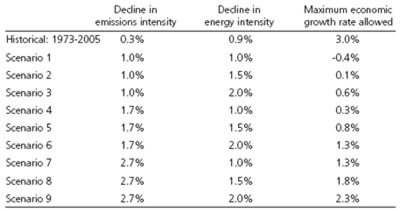
Can these emissions reduction targets be accomplished under the system of global capitalism, with its constant tendency towards accumulation of capital and economic growth? Table 1 presents several alternative scenarios of emissions reduction and economic growth that are consistent with a 63 percent reduction of emissions (which would allow for stabilizing CO2e in the atmosphere at 490 ppm), assuming global emissions peak in 2010 and decline thereafter. In other words, the intent is to point to some possible combinations of changes in energy intensity, emissions intensity, and economic growth that would meet the target of stabilizing CO2e levels at 490 ppm. These scenarios, while hypothetical and based on optimistic assumptions, highlight the dramatic changes necessary to stabilize CO2 levels. They help to illustrate that no sensible goals of climate stabilization can be accomplished under conditions of endless economic growth and capital accumulation.

As is discussed above, in many areas it is technically very difficult or impossible to replace direct consumption of fossil fuels with electricity. Nevertheless, in all scenarios, it is assumed that 50 percent of the fossil fuels final consumption will be electrified by 2050. Moreover, despite various limitations to carbon-captured, nuclear, and renewable electricity, in different scenarios, it is optimistically assumed that 50, 75, or 100 percent of the electricity generation currently using fossil fuels will be de-carbonized by 2050 (corresponding to average declines in emissions intensity of 1, 1.7, or 2.7 percent a year respectively). Energy intensity is assumed to fall by 33, 45, or 55 percent by 2050 (corresponding to average decline of 1, 1.5, and 2 percent a year respectively). With a 33 percent reduction of energy intensity, the world average would approach the average level of “energy efficiency” seen in “advanced” capitalist countries today. With a 45 or 55 percent reduction, the world average would be comparable to the “energy efficiency” levels of Western European countries today.13

The observed levels of “energy efficiency” in the advanced capitalist countries result not only from some advanced technologies, but also from the massive relocation of energy-intensive industries to the global periphery. This raises the question whether these “efficiency” levels can ever be accomplished by peripheral countries, making the assumptions of global improvements in efficiency of this magnitude highly optimistic. It is also important to recognize that the three factors assessed in these scenarios—emissions intensity, energy intensity, and economic growth—are not necessarily independent of one another. Certain changes in the types of fuel used to alter emissions intensity, for example, may adversely affect the potential to improve energy intensity or economic growth, and vice versa. However, in the presented scenarios, these problems are optimistically ignored.

Given the assumed declines in emissions intensity and energy intensity, one can then calculate the maximum economic growth rate that is consistent with the emissions reduction objective. For example, in scenario 1, assume that 50 percent of electricity generation currently using fossil fuels will be de-carbonized by 2050 (implying that emissions intensity declines at an average annual rate of 1 percent) and that energy intensity falls at an average annual rate of 1 percent. Then to reduce emissions by 63 percent from 2010 to 2050, the average annual economic growth rate from 2010 to 2050 must not exceed –0.4 percent, that is, the economy must contract. Similarly, in scenario 9, assume that 100 percent of electricity generation currently using fossil fuels will be de-carbonized by 2050 (implying that emissions intensity declines at an average annual rate of 2.7 percent) and energy intensity falls at an average annual rate of 2 percent, then the average annual economic growth rate from 2010 to 2050 must not exceed 2.3 percent.

It is clear from table 1 that the assumed declines in emissions intensity and energy intensity are much more dramatic than the historical performance of the global capitalist economy (what the IPCC refers to as “business as usual”) and the assumptions for all scenarios are, therefore, very optimistic. Nevertheless, in most of the scenarios, the world economy would have virtually to stagnate and in one scenario, the world economy actually needs to contract absolutely. And this is even assuming declines in emissions and energy intensity that exceed historical averages, and dramatically so in the case of emissions intensity, where the scenarios are based on a rate of improvement of at least more than three-fold and up to nine-fold the historical rates. Considering that the world population growth rate is about 1 percent a year, only the most optimistic scenarios would result in positive growth of per capita GDP.

Table 1. Stabilizing CO2e in atmosphere at 490 ppm, 2010-50: scenarios relying on various declines in emissions intensity of energy and energy intensity of the economy and the rates of economic growth they allow (annual rates of change).

Table 1: Stabilizing C02e in atmosphere...

Source: Historical data for world economic growth, energy consumption, and emissions are from World Bank, World Development Indicators Online,2008.

And even with these highly optimistic scenarios on atmospheric carbon stabilization, according to the IPCC estimate, the world would still warm by 2.4˚C (relative to pre-industrial times). Indeed, the IPCC projections fail to take into account many of the latest developments. The Arctic summer sea ice is now likely to disappear and the Arctic Ocean will, therefore, absorb more heat. An atmospheric concentration of CO2e of 490 ppm will probably lead to a global warming of 2.7˚C (rather than the 2.4˚C suggested by the IPCC report), taking the world dangerously close to the 3˚C threshold, which according to James Lovelock would amount to a global collective suicide by humanity.

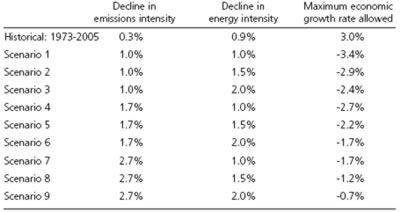
If the goal is to stabilize atmospheric concentration of CO2e at 445 ppm, instead of 490 ppm, then the global emissions need to fall by 89 percent, not just 63 percent. At 445 ppm, global temperature would still rise by 2˚C (relative to pre-industrial times). Some major ecological catastrophes would be unavoidable and dangerous climate feedback cycles could be initiated. Far more drastic cuts in global emissions would be required if the goal is truly to stabilize the climate and create a sufficiently large safety margin.

Table 2. Scenarios of emissions reduction and world economic growth (stabilizing CO2e in atmosphere at 445 ppm, 2010-50, annual rate of change).

Table 2: Scenarios of emissions reduction and world economic growth

Source: Historical data for world economic growth, energy consumption, and emissions are from World Bank, World Development Indicators Online,2008.

Table 2 presents the alternative scenarios of emissions reduction and economic growth that are consistent with an 89 percent reduction of emissions. The rest of the assumptions are the same as table 1. It turns out that the world economy would have to contract in all scenarios. For scenarios 1 to 3 (where the assumed declines in emissions intensity and energy intensity are clearly optimistic in comparison with the historical performance of global capitalism), the world economy would have to fall by two-thirds to three-quarters after 2010 to accomplish the objective of emissions reduction.

The results presented in tables 1 and 2 suggest that under no plausible circumstances could the objective of climate stabilization be compatible with the endless expansion of the global capitalist economy. However, the capitalist economic system is inherently incapable of operating with a non-growing (not to say contracting) economy.

The Politics of Climate Change and the Imperative for Socialism

Could this author be too pessimistic? Is the “ingenuity,” “innovativeness,” “adaptability,” and “resilience” of capitalism underestimated? The spokespersons of the mainstream environmental movement, such as Lester R. Brown (author of Plan B and director of Earth Policy Institute) and Amory Lovins (coauthor with Paul Hawken and L. Hunter Lovins of Natural Capitalism), try to convince us that magical technologies will come to the rescue. Solar panel costs will fall to the floor, as energy efficiency will surge ten-fold. Greenhouse gases emissions and other pollution can be reduced drastically, while gross domestic product will keep growing explosively. For them, there is no inherent conflict between production for profit and capital accumulation on the one hand and ecological sustainability on the other.

Their typical line of argument is that “the technology is already available” and “all that is needed is political will.” By “political will,” they are of course not referring to anything like fundamental social transformation. Instead, they are talking about some legislative reforms and international agreements within the basic capitalist framework. At most, they would demand some limited changes in personal consumer behavior.

The mainstream environmental movement, as far as its social composition is concerned, mainly consists of people who belong to the upper middle class in a capitalist society. They include the university professors, engineers, technicians, managers, financial analysts, and other professionals. Although they typically do not own significant amounts of the means of production, they play important managerial and technical functions for the capitalists and enjoy substantial material privileges relative to the working class.

In periods of revolutionary upsurge, such as in the 1960s, some of them could be rapidly radicalized and become various “ultra-leftists.” In periods of counter revolution, they could become the most important ally of the ruling class in the offensive against the working people. In the 1980s and ’90s, the upper middle class was an important social base for neoliberalism in many countries and they played a crucial role in the restoration of capitalism in the former Soviet Union, Eastern Europe, and China.

As the global ecological crisis deepens, some among the upper middle class recognize or sense that the existing capitalist “life style” is in serious trouble and cannot be sustained indefinitely. Yet, they are unable or unwilling to imagine anything beyond the capitalist system, on which their relatively privileged material life depends. They are not yet ready to give up their implicit political support for the capitalist class. Their living conditions and experiences are very much detached from those of the working class. It is therefore difficult for them to see that only with a massive mobilization and organization of the working class could there be any hope for the social transformation required for ecological sustainability to be accomplished. The upper-middle-class environmentalists, as a result, have to put their desperate hope (or faith) in technological miracles on the one hand and the power of moral persuasion on the other hand (which they hope would convince the capitalist class to behave morally and rationally).

However, the laws of motion of capitalism will keep operating so long as the capitalist system remains intact, independent of the individual wills and against the best wishes of the upper-middle-class environmentalists. Sooner or later, those truly conscientious environmentalists will have to choose between the commitment to ecological sustainability and the commitment to an exploitative and oppressive social system. Furthermore, with the deepening of the global ecological crisis and the crisis of global capitalism in general, it may soon become increasingly difficult for the capitalist system to accommodate the material privileges of the upper middle class while simultaneously meeting the requirements of production for profit and accumulation.

As I discussed earlier, there are many technical obstacles to the de-carbonization of the world’s energy system. Brown and Lovins have greatly exaggerated the potentials of technical change. But even if many of the proposed highly efficient energy technologies using renewables become available right away, their application will be delayed by the inherent obstacles to technological diffusion in the capitalist system. In an economic system based on production for profit, a new technology is “intellectual property.” People or countries that cannot afford to pay are denied access. Even today hundreds of millions of people in the world have no access to electricity. How many decades would it take before they start to have access to solar-powered electric cars?

Moreover, unlike consumer novelties such as cell phones or lap tops, which can be readily manufactured by the existing industrial system, the de-carbonization of the world’s energy system requires fundamental transformation of the world’s economic infrastructure. This basically means that the pace of de-carbonization, even under the most ideal conditions, cannot really be faster than the rate of depreciation of long-lasting fixed assets. Considering that many buildings and other long-lasting structures will stand for half a century or even longer, the assumed rates of de-carbonization presented in tables 1 and 2 must be seen as extremely optimistic.

From a purely technical point of view, the most simple and straightforward solution to the crisis of climate change is immediately to stop all economic growth and start to downsize world material consumption in an orderly manner until the greenhouse gases emissions fall to reasonable levels. This can obviously be accomplished with the existing technology. If all the current and potentially available de-carbonization technologies are introduced to all parts of the world as rapidly as possible, the world should still have the material production capacity to meet the basic needs of the entire world’s population even with a much smaller world economy (scenarios 1 to 3 in table 2 would roughly correspond to a return to the 1960s material living standards).

However, under a capitalist system, so long as the means of production and surplus value are owned by the capitalists, there are both incentives and pressures for the capitalists to use a substantial portion of the surplus value for capital accumulation. Unless surplus value is placed under social control, there is no way for capital accumulation (and therefore economic growth) not to take place. Moreover, given the enormous inequality in income and wealth distribution under capitalism, how could a global capitalist economy manage an orderly downsizing while meeting the basic needs of billions of people? Economic growth is indispensable for capitalism to alleviate its inherent social contradictions.

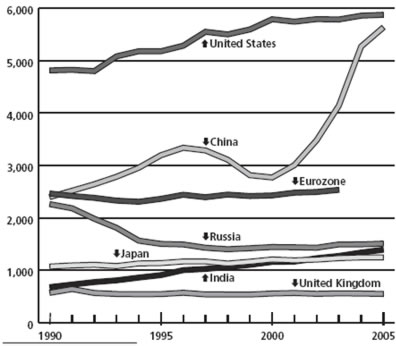
The Kyoto protocol requires that the advanced capitalist countries reduce their CO2 emissions by 5 percent from 1990 to 2012. Figure 1 presents the CO2 emissions of the world’s largest economies from 1990 to 2005.14 The United States refused to sign the protocol and U.S. emissions grew by 22 percent from 1990 to 2005. Among the signatories of the Kyoto protocol, Japan’s emissions grew by 16 percent and the Euro-zone emissions tended to grow since the mid-1990s. UK emissions (due mainly to its massive shift from coal to North Sea gas) have been on a flat trend.

Ironically, Russia is the only large economy that has reduced emissions substantially since 1990, during a period in which its economic output and population declined. Russia’s emissions fell by one-third from 1990 to 2005, with an annual rate of reduction of 2.7 percent. If the world economy were to repeat the Russian experience three times, that is, toexperience the kind of economic collapse that Russia experienced in the 1990s three times with a comparable reduction of emissions, then by 2050 the world emissions would fall by two-thirds. This would only allow the atmospheric concentration of CO2 equivalent to stabilize at about 490 ppm. As is discussed above, this would still fall short of what is necessary.

Chart 1. CO2 emissions, selected countries (millions of tons)

Chart 1: CO2 emissions, selected countries

Source: World Bank, World Development Indicators Online, http://devdata.worldbank.org/dataonline.

Since 1990, China’s emissions and India’s emissions have more than doubled, and China has now overtaken the United States to become the world’s largest emitter of greenhouse gases. At the current rate, China’s emissions will double in ten years and India’s will double in less than fifteen years. The European Union is currently committed to a reduction of emissions by 20 percent (from the 1990 levels) by 2020. All of this reduction would be offset by just one year of China’s economic growth. With the great Chinese capitalist boom, China now builds two coal-fired power plants every week. This means that every four years China will build as many coal-fired power plants as currently exist in the United States. What hope is there for climate stabilization with this kind of fanatical drive for accumulation? What magical technology can make this kind of capitalism sustainable?

It should be pointed out that the Chinese workers and peasants have not at all benefited from this relentless search for capitalist profit. It is the transnational corporations (who use China as the world’s “workshop”) and the Chinese capitalist elites that have reaped enormous profits from this. To a lesser extent, the upper middle classes in the advanced capitalist countries have also benefited from the cheap consumer goods and “services” produced by the workers in China, India, and other parts of the periphery.

On June 14, 2007, Financial Times published a quite bizarre article (“What is at risk is not the climate but freedom”) by Vaclav Klaus, the president of the Czech Republic and the former leader of the anticommunist “velvet revolution”:

We are living in strange times. One exceptionally warm winter is enough...for environmentalists and their followers to suggest radical measures to do something about the weather…Rational and freedom-loving people have to respond. The dictates of political correctness are strict and only one permitted truth, not for the first time in human history, is imposed on us…

[Global] warming hysteria has become a prime example of the truth versus propaganda problem. It requires courage to oppose the “established truth”…As someone who lived under communism for most of his life, I feel obliged to say that I see the biggest threat to freedom, democracy, the market economy and prosperity now in ambitious environmentalism, not communism. This ideology wants to replace the free and spontaneous evolution of mankind by a sort of central (now global) planning.

The freedom-loving President Klaus (who is apparently a good student of Friedrich Hayek) then demanded that scientists “have an obligation to declare their political and value assumptions and how much they have affected their selection and interpretation of scientific evidence.” Klaus then assured us that “advances in technology” and “increases in disposable wealth” will continue and “will solve any potential consequences of mild climate changes.”

One has to admit that it does take some courage for Klaus to defend “freedom” at a time when an important political consensus is being formed among the international bourgeoisie that the issue of climate change cannot be ignored any more. Given my own political experience and background in China (a former socialist state like Czechoslovakia), I do feel some strange familiarity with Klaus’s position.

Frankly, only an extremely reactionary politician who has deep-in-the-heart hatred of the working class and socialism could have made such outlandish comments. In one respect, however, Klaus is closer to the truth than all the mainstream environmentalists. It does take global “central” planning for humanity to overcome the crisis of climate change, if by “central” one is talking about self-conscious, rational coordination by democratic institutions.

The technical requirements for climate stabilization are clear. The global energy infrastructure needs to be fundamentally transformed to be based on renewables. Much of the world’s economic infrastructure will have to be changed accordingly. Agriculture will need to be reorganized to follow sustainable principles and to be freed from dependence on fossil fuels for fertilizers and machineries. The entire transportation system will have to be re-built, with railways and public transportation operated by renewable electricity playing prominent roles. The scale of the world economy will need to be reduced in accordance with the emissions reduction objectives. All of these need to be accomplished without undermining the basic needs of the world’s population.

It is clear that capitalism cannot accomplish these objectives. If we do not want to undermine the ecological conditions that support civilization, what else can accomplish these goals other than socialism with public ownership of the means of production and democratic planning?

So-called “market socialism” is not an option. Both theory and historical experience have demonstrated that “market socialism” inevitably leads to capitalism. Those who object to socialist planning might argue that the experience of historical socialisms suggested that socialist planning would be “inefficient.”

Leave aside the question that the future socialism would no doubt do better than the historical socialisms in democracy and economic efficiency, given the extreme gravity of the global ecological crisis, “efficiency” is simply not a relevant issue. The real question is: can socialism provide food, education, and health care to everyone on the earth? We know that historical socialisms were able to, and Cuba is still able to accomplish this with quite limited material resources.

Capitalism has always failed to provide food, education, and health care to at least hundreds of millions of people. If the global ecological crisis is not overcome, then capitalism will eventually fail the entirety of humanity. Is the choice not clear enough?

Notes
1. Intergovernmental Panel on Climate Change, “Summary for Policymakers of the Synthesis Report of the IPCC Fourth Assessment Report,” November 2007, http://www.ipcc.ch.
2. David Spratt, “The Big Melt: Lessons from the Arctic Summer of 2007,” October 2007, http://www.carbonequity.info/docs/arctic.html.
3. David Spratt and Philip Sutton, Climate Code Red (Friends of the Earth, 2008), http://www.climatecodred.net.
4. David Spratt and Philip Sutton, Climate Code Red; Jonathan Leake, “Fiddling with Figures while the Earth Burns,” Times Online, May 6 2007, http://www.ecolo.org/lovelock; James Lovelock, The Revenge of Gaia (New York: Basic Books, 2006), 15–38.
5. James Hansen et al., “Target Atmostpheric CO2: Where Should Humanity Aim?” (abstract), April 2008, (accessed May 2008). Also see John Bellamy Foster, “The Ecology of Destruction,” Monthly Review 58, no. 8 (2007): 1–14.
6. This is known as the Jevons Paradox, named after the nineteenth-century British economist William Stanley Jevons who first took note of this perverse effect. See Brett Clark and John Bellamy Foster, “William Stanley Jevons and The Coal Question,” Organization & Environment 14, no. 1 (2001): 93–98; John Bellamy Foster, Ecology Against Capitalism (New York: Monthly Review Press, 2002), 94–95.
7. Ted Trainer, Renewable Energy Cannot Sustain A Consumer Society (Dordrecht, Netherlands: Springer, 2007), 110–11.
8. Energy Watch Group, “Uranium Resources and Nuclear Energy,” EWG-Series No.1/2006 (December), http://www.energywatchgroup.org.
9. Michael H. Heusemann, “The Limits of Technological Solutions to Sustainable Development,” Clean Technology and Environmental Policy 5 (2003): 21–34. A recent experiment sponsored by the Germany government intends to show that a network with 61 percent of electricity from wind, 14 percent from solar photovoltaics, and 25 percent from biomass, can meet up to 100 percent of electricity demand (“Renewed Energy,” The Guardian, February 26, 2008). But as discussed below, biomass is very problematic and could emit more greenhouse gases than fossil fuels. Thus, the experiment suggests a 75 percent limit to de-carbonization of electricity generation.
10. The energy statistics discussed here and in the following paragraph are from: International Energy Agency, Key World Energy Statistics 2007.
11. Although there has been much talk of developing a “hydrogen economy,” hydrogen itself is not a primary energy source (i.e., there are no natural stores of hydrogen to be exploited). Hydrogen fuel is produced from water, a process which requires energy input. Thus, hydrogen is simply an energy storage mechanism (much like a battery), and its environmental consequences depend on the source of energy that is used to produce it.
12. Joseph Fargione, et al., “Land Clearing and the Biofuel Carbon Debt,” Science 319, no. 5867 (2008): 1235–38; Timothy Searchinger, et al., “Use of U.S. Croplands for Biofuels Increases Greenhouse Gases Through Emissions from Land-Use Change,” Science 319, no. 5867 (2008): 1238–40.
13. According to Key World Energy Statistics (see footnote 9), in 2005, measured by 2000 U.S. dollars, the energy intensity of OECD countries was 37 percent below the world average, France 41 percent below world average, Germany 44 percent below world average, and UK 56 percent below world average.

Tuesday, 15 July 2008

Forests and climate change – examining the spin

From Links magazine:

By Susan Austin

Tasmania, Australia -- It’s easy to get confused about the issue of forests and climate change. Climate scientists say that preserving our forests is a quick, easy and cheap way to prevent further global warming, and Australia’s previous federal government allocated A$200 million towards preserving forests in South-East Asia. Yet both the federal government and the Tasmanian state government are overseeing the continuing destruction of Tasmania’s old-growth forests to feed a profitable wood-chip export industry and a soon-to-be-built pulp mill. And what’s more, they say that the industry is carbon-positive and sustainable. What’s really going on?

``Action to preserve the remaining areas of natural forest is needed urgently”, wrote Sir Nicholas Stern, in his October 2006 Stern Review: The Economics of Climate Change, produced for the British government. And the Australian government’s consultant, Professor Ross Garnaut, in his interim report to the government on climate change, advocates re-forestation and forest conservation to provide breathing space for new technologies to “de-carbonise” our economy in the next decade before we trigger dangerous climate change.

Deforestation and forest degradation contribute to around 20 per cent of global greenhouse gas emissions, second only to the burning of fossil fuels to produce energy. The federal government’s Department of Climate Change website states: ``There is the potential to reduce these emissions by encouraging more sustainable forest management practices.”

Government double standards?

In March 2008, the Australian federal government, led by the Labor Party’s Prime Minister Kevin Rudd, announced the Papua New Guinea-Australia Forest Carbon Partnership, which is designed to reimburse PNG if it protects its forests from the axe by taking advantage of international carbon markets under the Kyoto Protocol.

This follows similar initiatives by the previous Liberal/National Coalition federal government, such as the “Global Initiative on Forests and Climate”, which was launched in March 2007 by the then-federal environment minister Malcolm Turnbull. That $200 million dollar scheme aimed to stop deforestation, particularly illegal logging in the South-East Asia and Pacific regions. In a speech to federal parliament on March 29, 2007, Turnbull praised the forests of the world for being “the lungs of the Earth” and gave us a little lesson in science: “The world’s forests play a vital role in addressing climate change because they store vast amounts of carbon for long periods of time. The carbon currently stored in forests around the world exceeds the levels of carbon in the Earth’s atmosphere. Dense tropical forest areas contain particularly high levels of carbon. As forests are unsustainably logged and as they are burned, they release large amounts of carbon into the atmosphere, contributing to global warming.”

It is no exaggeration to say that tropical rainforests are the lungs of the planet. Tropical forests cover 17% of the Earth's land mass, but account for more than a third of the world's plant growth and store roughly 40% of all the carbon in terrestrial life, plus a third or more of all the carbon stored in soils. "Tropical forests move more carbon in and out of the atmosphere than any other ecosystem", says Alan Townsend, an ecologist at the University of Colorado in the April 27 edition of Seed magazine. Tropical forests grow faster and take in more carbon, but they emit more carbon because the heat speeds up the rate of decay. Cool temperate forests like those in Tasmania and Victoria actually store more carbon that tropical ones, for example new science shows that mountain ash forests in central Victoria are among the most carbon dense in the world, storing up to 2500 tonnes of carbon per hectare.

Of course environmentalists support government initiatives to curb logging overseas, but they question governments’ unwillingness to practice what it preaches in their own backyards. Does it matter that a large percentage of logging in countries like Indonesia and PNG is illegal (i.e. it violates the country’s laws and regulations) while native forest logging in Tasmania is government sanctioned?

Australian Greens Senator Bob Brown responded to the 2007 announcement by saying: “Our Prime Minister is a forest fool. He believes the Australian people will be satisfied with him putting $200 million into South-East Asia while he licenses massive damage to the atmosphere through his own forest burning regime, authorised in southern Australia. It just doesn't make sense.”

Tasmania, the small island state at the southern end of the country, accounts for half Australia’s emissions from native forest logging, and is the focus of this article. According to the Wilderness Society, an average of 20,000 hectares of native forest are clear-felled and burnt each year in Tasmania (around 5000 hectares of which are high conservation-value old-growth forests). We have one of the highest rates of land clearing in the developed world, with well over 100,000 hectares of Tasmania’s native forest across public and private land having been converted to plantations in the last 10 years. On June 1, 2007, Forestry Tasmania (the state government-owned business responsible for “managing” Tasmania’s forests) and Gunns Ltd announced that they would end the conversion of native forests to plantations. But there were no champagne celebrations among greenies – everyone could see that they were still logging native forests, sowing seeds to convert the area into an even-aged monoculture that they planned to log again in the future, only they were calling this “re-growth native forest” rather than “plantations”.

The Programme for Endorsement of Forest Certification has certified forestry operations in Australia, including those in Tasmania, as being sustainable. Both levels of government (federal and state) and both major political parties (Liberal and Labor) claim that Tasmanian forestry practices are sustainable.

However almost all current harvesting in Tasmania’s mature mixed native forest is done by completely clearfelling an area with chainsaws and skidders, taking away the logs, piling all the left-over wood and debris up and using helicopters to drop incendiary napalm-like petroleum jelly onto it to create a high intensity fire (called a “regeneration burn”). The ash is then spread over the ground and new seedlings are sown to create a short rotation eucalypt monoculture. On private plantations the area is laced with 1080 poison that kills any wildlife (common and endangered species) who dare to feast on the tasty young plants.

Forestry Tasmania claims to be reducing its reliance on clear-felling by phasing in a practice called “variable or aggregated retention” which many regard as clear-felling by another name – the practice simply leaves 20 to 30 per cent of the trees left to stand in small clumps or islands in the sea of destruction. According to Timber Workers for Forests, these clumps are frequently scorched, burnt, wind thrown and fail to achieve their purpose of ecological preservation.

Forests on fire

Massive regeneration burns conducted throughout the state by Forestry Tasmania in autumn this year have once again ignited the debate about Tasmania’s forestry industry and its impact on our environment, health and society. Letters to the editor came pouring in from people living in the Huon Valley, Derwent Valley, Tasman Peninsula, Stanley and Maydena, including comments such as: “My wife has increasing levels of eye, nose and throat discomfort”; “When will we be able to breathe again?” and “My partner has a chronic lung condition and spent most of the recent lovely autumn weekend in bed, debilitated by the smoke”. Dr Fay Johnston, a respiratory health researcher from the Menzies Institute, said in a media release on April 24, “There is preliminary evidence that wood smoke could be worse for people’s health than car exhaust pollution.”

Greens member of the Tasmanian parliament Tim Morris said on April 24: “Year after year people with asthma and other respiratory problems are forced indoors to get away from this state-endorsed smoke pollution …This is completely unacceptable for both public health considerations as well as meeting our climate change commitments.”

The complaints haven’t just been about harmful effects to health and quality of life, but about the release of carbon into the atmosphere. With growing awareness of the seriousness of global warming, people aren’t prepared to sit back and watch their forests being turned into giant columns of smoke and ashes.

A Sunday Tasmanian report on April 27, 2008, noted that the amount of carbon released into the atmosphere from forestry burns could reach an estimated 1.54 million tonnes during this burn-off season, according to the forest industry’s own figures, which estimated in 2001 that the amount of carbon in the smoke of a wet eucalypt regeneration burn averaged 196 tonnes per hectare (which is likely to be a very conservative estimate).

Forest furnaces for power?

Under pressure from the public’s opposition to forestry burns, the timber industry has again raised a plan to establish biomass power plants to burn some of the larger pieces of forest residue to generate electricity, saying that this would reduce smoke from burn-offs and generate renewable electricity. In a media release on April 24, 2008, Forestry Tasmania said that “in light of the concerns highlighted during this year’s burning season” and because carbon trading is making renewable energy more economical, it was stepping up discussions with “a number of interested parties” about building a biomass plant, called Southwood, in the Huon region in southern Tasmania. Gunns Ltd also plans to attach a biomass plant to the planned pulp mill in the Tamar Valley, which would consume 500,000 tonnes of wood per year. Forestry Tasmania says that while large pieces of wood will be fed into these plants, it will still need to burn “some fine fuels on the forest floor” as “ash beds are necessary for regeneration”.

While many environmentalists, such as Mark Diesendorf, author of Greenhouse Solutions with Sustainable Energy advocate burning forestry and agricultural residue for fuel, they also insist that broader sustainability criteria would need to be met. Vica Bayley from the Wilderness Society told Green Left Weekly on May 30, 2008, that power generated from such plants would be recognised as a manifestation of forest destruction and there would be little market for power from logging. “Forestry Tasmania roll out the biomass plant idea every year when they are under public pressure about burning in the forests”, he told the April 24 Hobart Mercury. GreenPower, an Australian renewable energy endorser, has ruled out accepting power from burning native forests.

There are well-founded concerns that such power plants would lead to an expansion of logging practices solely to create power instead of serving as a useful way to deal with genuine logging waste, just as the woodchip industry was originally set up to make use of "waste" left over from the production of saw logs and now about 90% of all old-growth forests logged in Tasmania are done so solely to produce woodchips.

But what about bushfires?

Global warming causes drier, hotter conditions which increases the risk of bushfires. Dr David Bowman, a scientist from the University of Tasmania, pointed out at an April 23 public forum in Hobart sponsored by Environment Tasmania that in March 2008 Tasmania experienced the second-most extreme fire weather since 1940.

Forestry groups pretend not to understand why people complain about the smoke from post-logging regeneration burns but don’t speak up about pollution from natural bushfires or forest preservation practices like back-burning. It is obvious that climate change is already leading to more frequent and bigger bushfires which result in large amounts of carbon being released into the atmosphere (although nowhere near the amount released through regeneration burns), and back-burning helps to decrease their spread. On the other hand, regeneration burns are purposely lit carbon-emitting bonfires that add to global warming for the noble purpose of increasing company profits.

A study by Dean and others[1] in 2003 found that while 85% of carbon is lost when forests are logged and burnt, whereas an astonishingly small amount, only 2.4%, of forest carbon is lost when a natural fire passes through. It is also worth noting that mature forests are wetter, and are therefore less prone to bushfires.

Forestry practices – good or bad for the climate?

The debate about the climate change impacts of current forestry practices has been raging in Tasmania of late. Is the industry greenhouse positive, as it claims, or are the forest industry players really climate criminals, tearing down and trashing important carbon sinks? How much carbon is stored in old-growth forests versus managed plantations?

If you sat at home and perused the climate change section of Forestry Tasmania’s website you would be forgiven for believing that “Tasmania’s state forests are sucking carbon from the atmosphere at the rate of around 700 thousand tonnes per year, thanks to Forestry Tasmania’s management strategies…Each year, Tasmania’s forests are absorbing 24% of the entire state’s carbon emissions.” However, if you took a trip to the Weld or Florentine valleys in southern Tasmania, or to the Blue Tier on the east coast, you would see the ugly scarring of massive clear-fell operations and instantly question their assertion that “Our forest management practices are helping the planet.”

Forestry Tasmania’s website emphasises that “Tasmanian forests [are] a massive contributor to the fight against climate change”. Do we need to add “if you leave them standing”?

Carbon accounting

Forestry Tasmania makes much of the fact that, according to greenhouse accounting, it is the only industry sector that absorbs carbon. At an April 23, 2008, public forum on the issue in Hobart, Barry Chipman from Timber Communities Australia referred to the 2005 inventory of state emissions from the Australian Greenhouse Office when he claimed that “forestry is the only sector that is climate positive”. What does this inventory actually show?

In 2005 Tasmania’s total emissions from ``land use, land use change and forestry’’ (a category that excludes agriculture) added up to 2.99 megatonnes of carbon dioxide equivalent (CO2-e) into the atmosphere. According to the same data, emissions produced by this sector have dropped by 55.7% compared to 1990 levels. Even so, the 2005 emissions from this sector make up 27% of the overall emissions produced by the state. This is confirmed by the Tasmanian government in its 2006 Draft Climate Change Strategy for Tasmania, which includes a graph showing that ``land use change and forestry’’ emissions are the single biggest cause of greenhouse gases in Tasmania. However, instead of talking about ways to deal with this problem, the strategy praises the forestry sector and states: “Responsible stewardship of land and sustainable management of our forest resources, particularly reforestation and reduced deforestation, has provided a ‘sink’ reducing greenhouse gas emissions.”

Where do these forest industry claims of being “greenhouse positive” come from? If you look closer at the 2005 inventory you will see that the sector is broken down into two areas – “forestry” - which includes afforestation and reforestation - and “deforestation”. Afforestation is the artificial establishment of forests by planting or seeding in an area of bare or non-forested land. Reforestation is artificial or natural re-establishment of forest in an area that was previously under forest cover, or the restocking of existing forests and woodlands which have been depleted or chopped down. Under the 1997 Kyoto Protocol and the Australian Greenhouse Office inventories, both areas are grouped together to measure carbon dioxide uptake from plantations established from 1990 onwards on agricultural or cleared land. In Tasmania in 2005 this accounted for minus 2.13 megatonnes of emissions (i.e. a carbon sink, or greenhouse positive measurement). The data that the forestry industry studiously fails to mention is the +5.12 megatonnes of emissions found under the subsection of deforestation (defined quite simply as the conversion of forest to non-forest).

Peter Boyer, a Climate Project Presenter, wrote in the Mercury on April 29, 2008: “Under the Kyoto Protocol, clear-felling mature native forests to grow new trees doesn’t count as land-clearing, so carbon emitted from that activity is left out of the ledger. The result is that forestry gets a dream run in official emissions statistics.”

MBAC consulting, in its 2007 report for Forestry Tasmania, found that over 23 years to 2030, logging will release at least 28% of the carbon stored in the commercial forests Forest Tasmania manages. That is, while these forests stored 57 million tonnes in 2007, logging will reduce this to 41 million tones in 2030, followed by growth back to 64 million tonnes in 2050. MBAC also includes statistics of how much carbon is stored in non-commercial native forests to beef up its total carbon figures. Forestry Tasmania’s conclusion from the study is to look at the overall figures leading up to 2050 to boast on its website that “Tasmania’s state forests will absorb 31 million tonnes more atmospheric carbon than it will release, making them a net sink of carbon over the next 43 years”.

But talking in terms of 2050 figures obscures the picture of what is happening in the next 20 years, which many climate scientists say is the crucial window of opportunity when it comes to reducing our emissions. In fact forest operations in Tasmania will be net emitters of carbon each year until 2026, when growing forests will start taking up more than is given off.

Vica Bayley from the Wilderness Society said in an article in the Tasmanian Times on April 25, 2008: “Given the undeniable urgency in confronting climate change, for the forestry industry to continue to emit massive amounts of greenhouse gasses and deplete nature’s stores of carbon is a climate crime. For Tasmania to have to wait 22 years for positive carbon benefits from our forests is a major failure of our responsibility to future generations and a very poor example to set for the rest of the world.”

Dr Hans Drielsma from Forestry Tasmania says that carbon in production forests is balanced between that removed by harvesting and restored through regeneration. In Forestry Tasmania’s June 2007 Branchlines magazine he said this balance is maintained in Tasmania’s state forests. “Forestry Tasmania’s estimate of the carbon we release, through harvesting and regeneration burning as well as fuel and electricity usage, is balanced against the annual growth of the forest. We harvest around 15,000 hectares of State forest annually, but we have 1.5 million hectares that are growing.” He said that Forestry Tasmania ensures that the volume of forest at the end of a calculation period is the same as at the start.

However this seems to imply that forests of all types and all ages store similar amounts of carbon. In fact strong evidence is emerging that nothing can beat undisturbed mature native forests when it comes to storing carbon.

Carbon storage

No one is denying that young trees are faster growing and absorb carbon at a faster rate than mature trees. But mature forests are much better at storing it in wood, branches,

leaves, undergrowth, litter, roots, peat and soil. A United States Wilderness Society report, authored by Ann Ingerson and Dr. Wendy Loya[2] and released in April this year, shows that in general, the amount of carbon stored above ground in trees is less than half the forest carbon total.

When Barry Chipman from Timber Communities Australia spoke at the April 23 forum, he didn’t deny that clear-felling and carrying out regeneration burns releases carbon into the atmosphere, but he argued that the equivalent amount of CO2 is absorbed back when the forests grow again.

Dr Jerry F. Franklin, a professor with the University of Washington's College of Forest Resources, explained the problems with this approach well when he said: "Mature and old-growth forests can store or sequester extraordinary amounts of carbon …An analogy would be that older forests can be viewed as having very large capital reserves, whereas younger forests have high cash flow, or carbon uptake, but contain very little capital, such as sequestered carbon. There's also a high 'transaction cost' when you 'liquidate' this stored carbon by harvesting the forest. The harvested sites are significant carbon sources leaking carbon dioxide to the atmosphere for many years to decades following the harvest."[3]

Research clearly shows that native forests which have not been logged store up to three times more carbon than forests that have been logged. And up to 60% of the carbon in a Tasmanian wet eucalypt forest is stored in the soil.

Christopher Dean, Stephen Roxburgh and Brendan Mackay researched carbon levels in Eucalptus Regnans (a commonly logged species also known as mountain ash, swamp gum or stringy gum) in Victoria and Tasmania in 2003. They found that carbon storage increases in Eucalyptus Regnans up to 400 years old can approach 1500 tonnes of carbon per hectare. In contrast, after five cycles of logging every 80 years, forests tended to store an average of only 387 tonnes of carbon per hectare.[4]

A study by Roxburgh and others published in 2006 in the Journal of Applied Ecology predicted that it would take 53 years for a previously logged forest in temperate regions of Australia to reach 75% carbon carrying capacity, and 152 years to reach 90% of its original carbon storage capacity.[5]

The Wilderness Society says that detailed studies have shown that the whole of Australia’s intact eucalypt forests store on average around 650 tonnes of carbon per hectare – far more that the Intergovernmental Panel on Climate Change (IPCC) default values for temperate forests of 60 tonnes of carbon.

According to the National Carbon Accounting System Technical Report 17 from the Australian Greenhouse Office in 2000, plantations store much less carbon at around 122 tonnes per hectare.

So it is not enough to know that under the Australian government forest industry initiative, Vision 2020, the area of plantation forests in Australia is projected to increase by about 2 million hectares by 2020 over that present in 1996. The problem isn’t that most new plantations will be on agricultural land, although this raises questions about food security and priority of land use, but that plantations are not as effective at combating global warming as old-growth forests, which we urgently need to protect.

Not only do older forests store more carbon, but when forests or plantations are harvested regularly, other factors contribute to greenhouse gas emissions, such as increased drying and decomposition of the carbon stored in the soil, burning or acceleration of decay of biomass left on the site, the burning of fossil fuels to run the logging machinery and the log trucks which transport them long distances, and the short life of most of the end products.

Storage in timber products

At the April 23 public forum, Chipman displayed a nice slide with this quote from the Stern report: “If the timber is used in long-lived wood products it actually conserves carbon during the product’s lifetime.” Hans Drielsman from Forestry Tasmania (in the June 2007 Branchlines and at the public forum) stated that wood is a greenhouse-friendly product as it stores carbon, whereas every other type of building material including steel, aluminium, plastic and concrete takes a lot of energy to produce and are therefore responsible for high carbon emissions.

This is probably true but how much of the timber that is logged really goes into long-lived wood products? With 90% of our forests going into woodchips, pulp and eventually paper, there’s a cause for concern.

In a Green Institute paper written in September 2007 by Margaret Blakers, we discover that when you log native forests, 60% of the carbon is lost due to burning or decay, 23 per cent of the carbon is in exported woodchips (with a maximum life of three years), 11 per cent adds to landfill, and only 4 per cent adds to the store in longer lived wood products. In other words, the argument that wood products store significant amounts of CO2 relative to native forests has no validity. Almost all CO2 from wood processing is released within a few years, and the absolute maximum residence time of carbon in wood products is estimated at 90 years. Old-growth forests contain trees aged 200-300 years plus.[6]

In a speech to parliament on March 29, 2007, Malcolm Turnbull gloated: “Australia has a strong record in sustainable management of our forests.” He went on to detail that “some 13 per cent of Australia’s native forests – more than 22 million hectares – are protected in conservation reserves, including World Heritage sites and forested land under Indigenous ownership. Almost half of Australia’s tropical and temperate rainforests are protected. This includes more than 2.9 million hectares of forest (including 90 per cent of our high quality wilderness and 68 per cent of old-growth forest) added to conservation reserves since 1996 through our Regional Forest Agreement system.”

Even if we generously assume that his figures are correct, in this era of increased understanding about the alarming rate of global warming and the role of old-growth forests in storing carbon, the questions we need to be asking are: Why are only half of our rainforests being protected? Why are 32 per cent of our remaining old-growth forests still at risk of being turned into woodchips or burnt? Why are 87 per cent of our native forests not being protected for their climate-saving values? Why are corporate logging interests allowed to threaten our very future?

With the election of Kevin Rudd’s Labor Party government and the signing of the Kyoto Protocol in November 2007, many Australians were hopeful about finally seeing leadership on climate change. However as Tasmanian Weld Valley forest campaigner Warrick Jordon said in an April 24 press release, “Instead of protection of ancient forests, however, all we get is a lot of hot air about climate change. If the ALP (Australian Labor Party) was serious about climate change, they would be ending forest degradation in carbon rich old-growth forests."

Former Tasmanian Labor Premier Paul Lennon asked Professor Ross Garnaut, who is investigating economic aspects of climate change, to review the impact of logging. However there’s enough evidence around already without us having to wait for Garnaut’s final report – it’s plain to see that we need to protect our forests from those whose primary concerns relate to company profits and shareholder dividends. Instead we need to recognise our communal carbon bank and invest in the future.

The Gunns pulp mill – climate destroyer

Gunns Ltd, Australia’s largest woodchipping company, is forging ahead with its plans to build a $2 billion pulp mill in the Tamar Valley in the north of Tasmania, despite massive community opposition, which has taken the form of 10-15,000 people marching in repeated demonstrations at both ends of the state and over 6000 people signing pledges saying they will peacefully blockade the mill should its construction go ahead, even if it means going to jail.

Tasmanians Against the Pulp Mill is a thriving community-based protest movement that has been attracting over 100 people to its fortnightly campaign meetings for years now, and big environment groups like the Wilderness Society have been consistently voicing opposition to the mill in the media. Students Against the Pulp Mill has mobilised large numbers of high school students to walk out of school in protest, and a variety of other tourism, agriculture and fishing industry bodies have spoken out against the damage that the mill will cause to their industries.

The proposed pulp mill, one of the largest in the world, will use harmful chemicals, suck large amounts of water from local supplies, pump wastes directly into the ocean, cause major air pollution and further escalate old-growth logging. The government has been accused of corrupt practices by allowing the company to pull out of the independent environmental assessment process and introducing a special law to fast-track the mill’s approval. The issue has clearly radicalised people all over the state and awareness is growing across Australia.

The strength of the campaign has led to a number of victories, such as the May 26, 2008, resignation of the Premier Paul Lennon, who was a fanatical pulp mill supporter, and the recent news that ANZ bank was no longer prepared to finance the project.

On May 5, 2008, the Tasmanian Labor government admitted that it had signed a secret deal with Gunns and Forestry Tasmania that committed it to supplying wood to the proposed pulp mill for 20 years. The agreement even promised $15 million in taxpayer-funded compensation if any future government’s legislation interfered with the wood supply deal.

Accountant Naomi Edwards, in her submission to the Resource Planning and Development Commission in September 2006, said that “the pulp mill contract locks in over two million tonnes of state forest resource annually to the pulp mill, for a twenty year period, which locks in Gunns as a 70% plus monopsonist. Even if Forestry Tasmania is able to find a second customer producing a higher value product, it will not be possible to divert the wood resource away from the pulp mill. Further, Forestry Tasmania has existing contracts of supply in regard to woodchips, and Gunns has stated that it will need to continue with these woodchip exports in order to finance the pulp mill.”

Online campaigning group Climate Ark argues that Tasmania's logging industry already exports 5 million tones of pulp annually, and if built, the pulp mill will need another 4 million tonnes yearly, nearly doubling Gunns' current rate of clearfelling. Climate Ark claims the pulp mill will increase Australia's annual greenhouse gas contributions by more than 2 per cent.

Gunns says it will use between 3.2-4 million metric tonnes of pulpwood per year, compared to the current average of 4.7 million tonnes of pulpwood being exported. It says that it won’t lead to an intensification of logging but will divert resource that would otherwise have been exported in chip form to the pulp mill for value-added processing. However Gunns’ impact statement shows that the rate of woodchip production to feed all of its mills, including its woodchip export mills at Triabunna and Hampshire, will increase to 6.8 million tonnes per annum. It’s hard to find exact figures as information on native forest logging, wood-supply deals and woodchip contracts is often made exempt from freedom of information provisions and public Australian Bureau of Statistics reporting.

Gunns’ impact statement shows that at start-up the pulp mill will be 80% based on Tasmania’s native forests, with only 20% coming from plantations. Its graph shows that it will take 10 years for the plantation component to increase to 80%. The Wilderness Society says that in 25 years of operation, the pulp mill will consume more than 32 million tonnes of native forest, which will require the logging of more than 200,000 hectares of Tasmania’s native forests.

In the Wilderness Society’s submission to the pulp mill assessment panel, it claims that logging of native forests for the pulp mill will result in about 110 million tonnes of greenhouse pollution over the ten-year lifespan of the project (equivalent to 80 years of emissions from all the cars, buses and trucks currently on the road in Tasmania). The state government continues to support and subsidise this mill even though it has dramatic climate change implications.

More than 30,000 people have signed a Get Up petition calling on Professor Garnaut to examine the full impact of the logging that will feed the pulp mill before finalising his climate change report: “We ask that you provide a full carbon assessment of the impact of logging our forests, in particular Tasmania's forests destined for the pulp mill, including the serious carbon loss in converting native forests to plantations, the economic value in leaving them intact as sources of sequestration, and the role they can play in an emissions trading scheme."

Carbon trading and CDM

Will carbon trading be the savior of our old-growth forests? Many environmentalists in Tasmania are saying “yes”. Even before the Rudd government releases its plans for a national carbon trading system, Alistair Graham from the Tasmanian Conservation Trust said in a forum in Hobart on April 23, 2008, “we need to create a market for carbon so that we can say that it’s worth more to preserve our forests than to chop them down”. Peg Putt, state MP and leader of the Tasmanian Greens said on May 6, 2008, “Tasmania is in the box seat to gain a big financial windfall when carbon trading gets underway to counter climate change, as there is a very real prospect that we will make a lot more money from keeping forests growing as carbon stores than logging them for pulp.”[7]

Timber Workers for Forests, in its submission to Forestry Tasmania’s Draft Forest Management Plan 2008-2017, criticised the plan for not mentioning carbon trading, nor detailing the amounts of carbon stored in old-growth forest, mature mixed native forest, re-growth forest and plantations or developing strategies to maximise carbon storage.

Any carbon trading scheme involving forests requires a good understanding of carbon storage and carbon accounting in different types of forests and soils. The federal government’s Department of Climate Change is busy working with other partners on developing an internationally recognised system of monitoring forests and their carbon content so that forests can become part of the carbon market. It aims to extend Australia’s National Carbon Accounting System (NCAS) to do this.

A global carbon trading scheme was set up under the Kyoto Protocol and includes the Clean Development Mechanism, which allows Western companies that expect to exceed their emissions cap to carry on polluting, provided they invest in projects that result in corresponding emissions cuts in the developing world. The total value of such trades reached US$60 billion last year. As the world is already negotiating the next Kyoto protocol, to take effect in 2013, many groups and governments are pushing for the CDM to be expanded so that projects such as the protection of tropical forests and even soil conservation will be eligible for carbon credits (at the moment only the planting of trees on previously cleared land is eligible for credits).

Making forestry projects eligible for carbon credits brings up the problem of permanence, because many forestry projects are temporary in nature, since carbon dioxide captured during forest growth can be disturbed by fire or drought or released upon harvest.

Using carbon trading as a method of protecting native forests may bring up some problems. For example, for projects to gain CDM status, they may have to show that they are additional, and not part of normal planning, i.e. to apply for carbon credits from a forest preservation project you would need to prove that you were protecting forests that would otherwise be condemned to destruction. Where is the incentive for government’s to place these forests under protection now, before a carbon trading scheme commences, if in doing so, lose the potential to gain an income from protecting them later on? And should Gunns get paid to protect our native forests? Whose forests are they?

Carbon trading may be too slow and bureaucratic when compared to the possibilities offered by quick, effective regulation of forest protection, delivered by a government prepared to fund a transition plan for forestry workers into sustainable alternative employment.

There is also the broader problem of companies using the CDM scheme to “offset” their own pollution, thereby not reducing overall levels of CO2 emissions. Australian of the Year (2007) and environmentalist Professor Tim Flannery presented a submission to Professor Garnaut’s climate change review in January 2008 proposing an internet-based carbon market with a pilot scheme to be run in Papua New Guinea. First raised in a presentation in Port Moresby in August 2007, Flannery’s scheme envisages that households and businesses would be able to secure the protection of forests and the replanting of trees through an auction scheme. Buyers would identify vulnerable forest land online, using internet technology like Google Earth, and then make bids to secure its protection through a site like eBay. If the bid is accepted by the village, the funds would be held in trust by a non-government organisation until the agreed protection of biodiversity or carbon sequestration has been delivered. Buyers would get credits to offset industrial emissions, villagers would get paid for preserving their forests and biodiversity would be protected.

Even though Flannery’s submission acknowledges that the industrialised world has “inflict[ed] a historic debt of 200 gigatonnes of carbon on humanity’s common atmosphere”, he still seems to support the idea that carbon-emitting businesses in industrialised countries like Australia should be able to receive credits for protecting forests in other countries, while continuing to emit carbon themselves.

Socialist approaches to forestry

The forestry workers’ union in Tasmania has joined with Gunns and the government in arguing against any changes to the practices of old-growth logging. It also strongly supports the pulp mill. The union’s arguments all centre around jobs. But socialists know that workers do not have to choose between jobs or the environment – with proper planning we can have both. In fact, jobs have been falling in the logging industry for some years, and private contractors are at the mercy of Gunns, a giant company that has no commitment to ensuring timber workers have a secure livelihood. Many more long-lasting jobs could be sourced by supporting a sustainable timber industry that employs workers to manage preserved forests, to run popular eco-tourism ventures like the already existing Tahune Airwalk and to selectively harvest logs for real value-added processing.

Our native forests should be under public control and managed in the public interest, not sold to Gunns for a pittance. As preserving mature forests has been recognised as a cheap strategy for dealing with climate change, the government needs to step in, nationalise Gunns and protect our forests for the kinds of environmental benefits that won’t show up in a private company’s accounting systems. (See the Socialist Alliance’s ``Open Letter to Timber Workers about the Pulp Mill’’ at http://www.socialist-alliance.org/tasmania/ for more detail on jobs, the pulp mill and forestry practices.)

How climate change impacts on forests

Will we always be able to rely on our forests being carbon sinks?

Some of the research coming out in the last few years has scary implications. Even if we do stop logging and burning our forests, unless we work hard to reduce other sources of emissions, global warming may catch up with us and change the very nature of our forests and their ability to store carbon.

The amount of carbon that a forest stores depends on the balance between the rate at which it draws carbon dioxide from the atmosphere through photosynthesis and the rate at which it gives carbon dioxide back through respiration.

Scientists such as David and Deborah Clark from the La Selva Biological Station in Costa Rica are finding that tree growth rates in tropical rainforests start to slow down when temperatures increase. Slow growth rates mean that they take in less carbon dioxide but the trees continue to respirate, or breathe, releasing CO2 into the atmosphere. As global temperatures continue to rise, there will come a point where forests will start to emit more CO2 than they soak up. This will further increase the effects of global warming, a cycle known as a “positive feedback loop”.[8]

A study by Ken Feeley of Harvard University in Boston which was reported in the August 11, 2007, Malaysia Sun in showed that rising average temperatures have reduced growth rates by up to 50 per cent in the two rainforests in Panama and Malaysia, which have both experienced climate warming above the world average over the past few decades.[9]

In a paper in the March 11, 2004, issue of Nature, William Laurance and colleagues reported that tall, relatively fast-growing canopy trees in Amazonia were growing faster than they were in the 1980s and slower-growing trees that live their whole lives below the canopy were becoming rarer. After investigating other possible causes, they speculate that rising levels of CO2 in the atmosphere may to be blame. It is a worrying trend, because under storey trees grow slowly and produce denser wood, which in turn means that the carbon content of each tree is greater. If the forest composition shifts away from these trees toward faster-growing genera with lighter wood, the forest will be less able to take up CO2.
Research released in October 2007 by the Global Carbon Project, reported in Climate Code Red, confirmed that there is more CO2 in the atmosphere, partly because of a slow-down of natural sinks. “Fifty years ago, for every tonne of CO2 emitted, 600kg were removed by land and ocean sinks. However, in 2006, only 550kg were removed per tonne and that amount is falling”, concluded project leader Dr Pep Canadell.[10]

A summary of some of the Hadley Centre’s modeling work published in 2005 and referred to in Climate Code Red included two startling graphs. In one, the amount of total carbon stored in the Amazonian vegetation and soils shows a drop from around 70 billion tonnes of carbon in 2000 to just 20 billion tonnes of carbon by 2100. The second, using the same technique, compares vegetation and soil carbon levels in 2100 to 1850: while vegetation carbon had increased by about 60 billion tonnes of carbon by 2100, the amount of soil carbon had decreased by 130 billion tonnes of carbon.

So the ability of our forests to store carbon and assist in the fight against global warming is actually decreasing as the planet warms. And this is without taking into account the negative effects of increasing numbers of droughts and wildfires on forests. So it is clear that while it is vitally important to preserve the Earth’s remaining native forests in their natural state, we must also act quickly to reduce our overall emissions, by doing things like phasing out fossil fuel use, if we are to protect nature’s precious equilibrium and avert climate catastrophe.

[Susan Austin is an environmental activist in Tasmania and a member of the Democratic Socialist Perspective, a Marxist tendency within the Socialist Alliance of Australia.]

Notes

1. Dean, C., Mackey, B.G., and Roxburgh, S.H. (2003), ``Growth Modelling of Eucalyptus regnans for carbon accounting at the landscape scale’’, in Amaro, A., Reed, D., Soares, P. (eds.), Modelling Forest systems, CABI Publishing, Walliford, UK.

2. Ann Ingerson and Dr. Wendy Loya, Measuring Forest Carbon: Strengths and Weaknesses of Available Tools, United States Wilderness Society, April 2008. Report summary available at http://wilderness.org/Library/Documents/Measuring-Forest-Carbon.cfm or full pdf at http://wilderness.org/Library/Documents/upload/FR7-28carbonbrief.pdf.

3. US Wilderness Society media release, April 9, 2008, http://www.wilderness.org/NewsRoom/Release/Analysis-Shows-American-Forests-Contain-Enormous-Carbon-Reserves.cfm

4. See Note 2.

5. Roxburgh, S.H., Wood, S.W., Mackey, B.G., Woldendorp, G. and Gibbons, P., ``Assessing the carbon sequestration potential of managed forests: a case study from temperate Australia’’, Journal of Applied Ecology, Volume 43, Number 6, December 2006, pp. 1149-1159.

6. Green Institute Working Paper 2 “Forests: vital for climate protection”, http://www.greeninstitute.com.au/images/uploads/Forests_-_vital_for_climate_protection.pdf.

7. Media release, http://tas.greens.org.au/News/view_MR.php?ActionID=2976.

8. Hillary Rosner, ``Rainforests – Carbon sink or carbon source?’’ by Hillary Rosner, posted April 27, 2006, http://seedmagazine.com/news/2006/04/the_truth_about_rainforests_1.php?page=all

9. http://story.malaysiasun.com/index.php/ct/9/cid/48cba686fe041718/id/272618/cs/1/

10. http://www.climatecodered.net/