Showing posts with label Germany. Show all posts

Monday, 23 November 2009

Video: Was the German Election a Turning Point?


LeftStreamed, November 13, 2009:

Finance, Class and Politics in the European Economic Crisis:
Was the German Election a Turning Point?

As a result of the recent German elections, Conservative Chancellor Angela Merkel, who was leading a coalition government with the social democratic SPD (Social Democratic Party) since 2005, will also lead Germany's next government, this time with support from the liberal FDP (Free Democratic Party). Though the social democrats expected that their party, the SPD, would continue the downward trend that began with the 2002 elections and continued in 2005, the loss of 11.2% of the vote came as a shock. The 23.0% they received in this year's election was even lower than the 29.2% with which the SPD started their electoral performance in post-war (West) Germany.

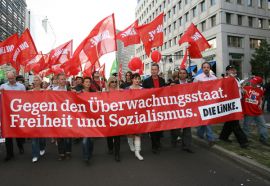
The 11.9% for the Left Party (Die Linke) does not look too impressive numerically, but it does signify the establishment of the party as a constant factor in Germany's political system. Considering that the party was only founded as a merger of East Germany's Party of Democratic Socialism (PDS) and West-German SPD dissidents in 2007, this is a remarkable achievement that indicates the desire for a left voice in the parliamentary arena.

At this point, the Left Party is the only party in opposition to the restoration of neoliberalism. It would also be the key point of coalescing if any further rightwing turn in German politics occurs. From this angle, the significance of the electoral boost of the Left Party lies less in increased presence in parliament. It lies in the stabilization of a political force that began, however vaguely, to advocate alternatives to neoliberalism at a time when that doctrine still seemed to be the only way of economic and social development. Whether the Left Party is ready to live up to these openings is an entirely different question. It is also possible that the party gets torn apart between the temptation of occupying government positions and building the base for independent working class political action, or even a wider rebellion.

These issues served as the basis for a roundtable discussion of Die Linke and the coming period of struggle in Germany over exit strategies to the financial crisis.

Click here to view the video and other useful resources.

Friday, 13 November 2009

Taxing the super-rich is a no-brainer

By Kevin McVey
First published in The Morning Star, Thursday, 12 November, 2009

The German press reported the launch of a petition two weeks ago calling for extra taxes on the rich.

Nothing unusual about that. The idea of the rich paying their fair share of taxes has been one of the clarion calls of the left internationally for a generation.

But this petition wasn't launched by Die Linke, nor by the trade unions. The petition was launched by a group calling itself Vermoegende fur eine Vermoegensabgabe, which translates as "wealthy people in favour of a wealth tax."

According to the organisers, a 5 per cent wealth tax for two years on everyone in Germany with a personal fortune over 500,000 euros (£452,000) would raise more than 100 billion euros (£90bn).

The group says that the revenues should be earmarked for environmental protection, education, health care, welfare and other social services.

"The gap between the poor and the rich in Germany has widened during the past 15 years," explained one of the organisers.

The proposal bears a remarkable similarity to the proposal put forward by the Scottish Socialist Party during the recent European election campaign and in the Glasgow North East by-election.

The Scottish Socialist Party (SSP) has calculated that a one-off tax on every individual in the UK who holds liquid assets - ie wealth held in bank accounts, stocks, shares, bonds etc - worth over £1m would instantly generate up to £70bn.

This single measure would be enough to create and sustain 800,000 new jobs - a fiscal stimulus on a grand scale, which would rejuvenate local economies and generate billions of pounds in extra tax revenues.

Let's be clear. The crisis engulfing the world economy was caused by the greed, incompetence and recklessness of the private sector and the rich.

Yet with varying degrees of enthusiasm, all the mainstream parties are drawing plans for an onslaught against the public sector and the poor.

They have learned no lessons from the global economic meltdown, which has its roots in runaway economic inequality.

Higher taxes on the rich over the past 13 years of new Labour in power wouldn't have prevented an economic downswing. But it certainly would have curbed the wild excesses of casino capitalism.

For a decade and more, the rich amassed phenomenal wealth. This became the fuel powering the soaring speculative rocket, which has now fallen back to Earth like a burned-out stick.

In the past, even the most modest proposals for wealth redistribution provoked derision and hysteria from new Labour politicians.

To take a local example, when the SSP proposed replacing the council tax with a more equitable service tax based on income, the Scottish Labour Party issued a briefing paper saying that the policy would "lead to a haemorrhaging of wealth."

Haemorrhage? It sounds like a cruel joke now.

We only wanted the rich to donate a pint of blood. Instead they decided to slash their own arteries.

Incredibly, even after the greatest financial crash since 1929, the richest 1,000 people in Britain are still three times richer than they were on the day new Labour came to power. That's the state of play in Britain now according to the latest Sunday Times rich list.

Every one of these 1,000 people could go on another spending binge, each splashing out £1m every week for the next five years, and they would still have billions left to spare.

Slap some extra taxes on these people and they wouldn't even notice the difference. They might scream and squeal for a bit, but they won't be cutting back on spending at their local restaurant or corner shop.

Transfer that money to the millions who live on or near the breadline and they'll spend it.

It's simple economics - and in Germany even some millionaires have begun to work out that particular equation.

Kevin McVey was the SSP candidate in the Glasgow North East by-election.

Tuesday, 6 October 2009

Germany: Big gains for Die Linke as Social Democrats’ support collapses

via Links - International Journal of Socialist Renewal:

By Duroyan Fertl

October 5, 2009 – Germany’s ``centre-right’’ Chancellor Angela Merkel was returned to power in federal elections held on September 27, but with a record low voter turnout and an increased vote for the far-left party, Die Linke (The Left).

The election was a clear success for Merkel and her Christian Democratic Union (CDU). Her preferred coalition partner – the free-market fundamentalist Free Democratic Party (FDP) – increased its support by 4.8 per cent to an all-time high of 14.6 per cent, enough to form a CDU-FDP government. The FDP will now replace the CDU’s main rival – the ``centre-left’’ Social Democratic Party (SPD) – as coalition partner in the government of Europe’s largest economy.

At the same time, the SPD’s support collapsed by more than 6 million votes, dropping a massive11.2 per cent to only 23 per cent – its worst result since World War II. As one leading SPD member pointed out on election night, “We have been bombed back into the Weimar Republic”. SPD leader Walter Steinmeier described the result as “a bitter day” for German social democracy.

However, while the result has been widely characterised as a shift to the right, that view is not really borne out by the results. The total vote for the centre-right parties rose by only 3.4 per cent, while the vote for the neo-Nazi New Democratic Party (NPD) dropped to just over 1 per cent, while the total left vote dropped by only 5.4 per cent.

Voter turnout slumps

The election campaign was one of the dullest ever run, with the two major parties – CDU and SPD – being overly polite to each other, neither wanting to alienate voters or lose their chance of remaining in government.

In a televised “debate”, Steinmeier and Merkel acted like old chums, and the unofficial slogan of the entire campaign became “Yes we gähn” (“Yes we yawn”). As Dietmar Bartsch, Die Linke’s general secretary, explained: "It was a very boring affair. None of them were any good. It was exactly what we had expected."

After 11 years in government, presiding over increasing cuts to social welfare and rising poverty and unemployment, the SPD lost the confidence of many of its traditional supporters, and was barely able to distinguish its own neoliberal policies from those of its main rival during the election campaign.

The SPD’s support was also impacted by its refusal to consider going into coalition with the far-left Die Linke, making a vote for an SPD government essentially a vote for the status quo, and another “grand coalition” with the CDU.

Some disaffected SPD supporters shifted their votes to Die Linke or to the Greens, but millions simply stayed home, enjoying a last warm weekend before winter. In fact, the voter turnout was the worst in 60 years, down to 70.8 per cent from 77.7 per cent four years ago, and most of those voters were once SPD voters.

While the CDU managed to retain government, it also suffered a drop in its vote, down by 1.4 per cent to 33.8 per cent, also a record low. And while the CDU-FDP coalition won a slender majority in the Bundestag – the German parliament’s lower house – various left-wing parties still have a majority in the upper house (the Bundesrat),which is made up of representatives from state governments.

The new CDU-FDP government is expected to introduce widespread cuts to social spending, especially under the influence of the FDP. Although the more conservative CDU will temper the FDP’s neoliberal urges, the new government has promised to introduce tax cuts of up to 20 per cent, reduce public spending, reverse the phase out of nuclear reactors, increase the pension age to 67 and continue Germany’s military involvement in the occupation Afghanistan.

Die Linke

The real success stories of the elections were the minor parties. The big winner was the right-wing FDP, whose increased vote makes them the third-biggest party in parliament. The Greens also entered double figures for the first time in a federal election, with 10.7 per cent, and increasing its presence from 51 to 68 seats.

The far-left Die Linke – the newest party in Germany’s political landscape – won 10.9 per cent of the vote, an increase of 3.2 per cent on 2005. It is the first time in German history that a party to the left of the SPD has scored more than 10 per cent in an election. Die Linke’s representation in the Bundestag has increased from 54 to 76 MPs, 40 of whom are women.

Die Linke was formed in 2007 when the Party of Democratic Socialism (the successor to the former ruling Socialist Unity Party of the German Democratic Republic – ``East Germany’’) merged with the Electoral Alternative for Social Justice and Jobs (WASG) – a group of disillusioned SPD members, trade unionists and socialists formed in 2005 to oppose the right-wing policies of the SPD-Green coalition federal government of the time.

Since then. Die Linke has continued to increase in popularity despite a media scare campaign about the threat of “communism”. Die Linke’s election platform of improved social justice and public welfare, the introduction of a minimum wage, higher taxes for the rich, relaxing harsh unemployment laws and cutting greenhouse gases emissions by 90% by 2050 have resonated with an electorate suffering the effects of the economic crisis.

Unemployment is already more than 8 per cent and will continue to rise as Germany’s export-dependent economy tries to ride out the crisis. Well over 10 per cent of Germany’s population already lives below the poverty line.

While more than 80 per cent of the population is opposed to the war in Afghanistan, Die Linke is the only party calling for the removal of German troops.

In two years, Die Linke has now won seats in 10 of Germany’s 12 state parliaments. In the western state of Saarland, an SPD heartland and home to Die Linke spokesperson Oskar Lafontaine, the Die Linke won more than 21.3 percent of the vote in state elections in September, placing it just behind the SPD. In Bremen, Die Linke scored more than 14 per cent, and even in the conservative state of Bavaria Die Linke’s support more than doubled, reaching 6.5 per cent.

In the states of the former German Democratic Republic, Die Linke fared even better, becoming the second-biggest party in the region after the CDU, and well ahead of the SPD. Die Linke won more than 25 per cent support in a majority of eastern electorates, and leading members Gregor Gysi and Petra Pau won their seats in Berlin with nearly 50 per cent of the vote.

In state elections held on the same day as the federal poll, Die Linke also entered parliament for the first time in Schleswig-Holstein – winning 6 per cent of the vote and five seats in the legislature – while in the eastern state of Brandenburg, it received 27.2 per cent, just behind the SPD on 33 per cent.

Can the SPD move left?

The SPD’s disastrous results, and the increased support for Die Linke, mean the SPD leadership is under significant pressure to move the party to the left and work with Die Linke, or risk losing more support. Adding to that pressure, a recent survey found that more than 50 per cent of Germans think that socialism is a good idea, but had been badly applied.

Die Linke co-leaders Oskar Lafontaine and Gregor Gysi have both called upon the SPD to “re-social-democratise” in order to build a strong left-wing alliance against the new government. According to Die Linke’s deputy leader – and ex-SPD member – Klaus Ernst, if the SPD does not change “the last one out can turn off the light”.

This may not be as easy as time seems, however, as many SPD members still hold a visceral hatred for Lafontaine. As former chairperson of the SPD and former federal finance minister, Lafontaine is considered to be a “traitor” to the SPD. Lafontaine resigned from the SPD in 2005 in protest against anti-social policies of SPD Chancellor Gerhard Schroeder. He became a central leader of Die Linke, and an outspoken critic of both SPD policy and “finance capitalism” more generally.

So, while Die Linke has eclipsed the SPD in a number of state elections, and has indicated its willingness to enter coalitions with the SPD and the Greens to fight the looming attacks on public spending, in government as well as on the streets, it is unclear if the SPD will cooperate.

Only days after the federal election, the SPD in the eastern state of Thuringia refused to form a coalition with Die Linke – despite indicating it would do so during the election campaign. Although already in coalition with Die Linke in Berlin and Brandenburg, in Thuringia the SPD have chosen instead to work with the right-wing CDU.

There can be no guarantee, then, that the SPD will move quickly to the left or develop a coherent relationship with Die Linke, a situation which means that the social resistance to the new government’s spending cuts and reforms will be weakened.

Despite its significant gains, Die Linke is faced with a new series of challenges. As the clearest opposition voice and defender of social programs and public welfare, Die Linke must now find a way to relate to the millions of disillusioned SPD voters, and to organise the strongest possible response to the economic crisis and the pro-business policies of a right-wing government.

Friday, 2 October 2009

Das Ende der SPD?

Following the recent elections in Germany (more to follow), we thought this might be worth sharing...


Tuesday, 3 February 2009

Germany: Die Linke, Hesse and the `super election’ year

Oskar Lafontaine

By Duroyan Fertl, via LINKS - International Journal of Socialist Renewal

January 29, 2009 -- Germany kicked off a “super election year” on January 18 when voters in the western German state of Hesse returned to the polls for the second time in twelve months. The new election had become necessary after months of negotiations to form a coalition government collapsed late last year, when four parliamentary members of the Social Democratic Party (SPD) rebelled against a plan to form government with the assistance of the far-left party, Die Linke.

The SPD had benefited in last year’s poll from voter rejection of the racist scapegoating and law-and-order politics of the ruling right-wing Christian Democratic Union (CDU) and Prime Minister Roland Koch. Despite its vote, however, the SPD still lacked the numbers to form government, even with its preferred allies, the Green Party, and the SPD’s leader in Hesse, Andrea Ypsilanti, turned to Die Linke for support.

In the lead-up to the election, however, Ypsilanti had bowed to pressure from SPD hardliners and promised not to deal with the Die Linke. Many in the dominant right wing of the SPD have an almost irrational dislike of the left-wing party, partly fuelled by the fact that it formed in out of a fusion of the Party for Democratic Socialism (PDS – the successor to the former East Germany or German Democratic Republic’s ruling party, the Socialist Unity Party) with the WASG (Electoral Alternative for Social Justice and Jobs) – a group made up of radical trade unionists and breakaways from the SPD, included former SPD chairperson Oskar Lafontaine.

Nevertheless, when neither the SPD nor the CDU were able to form government with their preferred alliance partners – the Greens for the SPD and the radical free-marketeers of the Free Democratic Party (FDP) for the CDU – Ypsilanti backflipped on her promise in order to win government, securing an agreement with the Greens and Die Linke, but losing support in her own party.

All attempts to form government having fallen through, the Hesse parliament was left with little choice but to dissolve itself, which it did on November 19, 2008, forcing new elections, and the left-leaning Ypsilanti was forced to step aside in disgrace, to be replaced as candidate with Thorsten Schäfer-Gümbel, a relatively unknown SPD backbencher.

The January election resulted in a further disaster for the SPD, which has been battling poor polling for months, and is desperate to restore its fortunes by winning state government. Its support dropped thirteen points to only 23 per cent – the worst result in the party’s history, a fact made bearable only by the fact that the CDU’s showing was equally unimpressive. They managed only a 0.4 per cent increase on last year’s result of 36.8 per cent, making this its worst result in Hesse as well.

While voters punished both the SPD and CDU, the main beneficiaries in the election were the minor parties – the Greens’ vote almost doubled to 14 per cent, while support for the FDP rose from 10 to 16 per cent. Many more people simply refused to vote, however, and the election saw voter turnout in Hesse drop to an all-time low of 61 per cent.

While the SPD lost considerable support, it is perhaps surprising that Die Linke – which aims to win over disenfranchised SPD supporters – achieved only moderate gains, increasing its support by 0.3 per cent to 5.4 per cent. While failing to capitalise immediately from the SPD’s disarray, Die Linke has nevertheless managed to hold on to the six parliamentary seats it won last year – still a major breakthrough for the young party.

In the end, then, after twelve months of caretaker government, incumbent CDU Prime Minister Koch has been returned to power, in alliance with a strengthened FDP, a political constellation that many see as the likely outcome in the federal election due for later this year.

SPD in crisis

In the wake of the Hesse results, the SPD remains in total disarray, having lost considerable support due to its anti-social fee-market policies, for which it lost government in 2005. Support has dropped to a dismal 22 per cent nationwide, well behind the CDU on 37 per cent, and the SPD is desperate for political victories to revive it in this important federal election year.

Having replaced unpopular national leader Kurt Beck – who flip-flopped on the question of working with Die Linke – with the machiavellian Franz Münterfering, the SPD was hoping for a revival of its fortunes. However, as the unwilling junior partners in a federal “Grand Coalition” government alongside the right-wing CDU, the SPD is continuing to implement neoliberal policies, further alienating its traditional support base, which is already suffering the effects of the economic crisis.

When the German economy fell into recession late last year, the CDU/SPD government’s response was to announce a €480 billion “bail-out” of the country’s major banks. At the very same time, unemployment in Germany is expected to rise by nearly 1 million over the next few months, and the country is facing a poverty rate that is estimated to stand as high as 18 per cent, and it is rapidly rising.

There are already suggestions that the country’s second largest private bank, Commerzbank, is using its first €10 billion ($20 billion) handout simply to finance a takeover bid of Dresdner Bank, while the major German banks are already calling for a second “emergency bailout” to divest them of a claimed €300 in “toxic debts”.

At the same time, workers’ industrial action is on the rise in Germany. Last November, more than 500,000 metalworkers held short strikes across southern Germany, demanding an 8 per cent wage increase, and Lufthansa workers at Frankfurt airport are currently threatening strike action, also over wages.

`Super election’ year

Germans will vote this year in sixteen polls, including local, European and presidential elections, as well as state elections in Saarland, Saxony, Thuringia and Brandenburg, before the federal elections on September 27. In the former East Germany, Die Linke maintains popular support of more than 25 per cent, where it has built on its former PDS support base. In many of these eastern states, such as Thuringia and Saxony, Die Linke is expected to outpoll the SPD, and support for Die Linke is expected to grow as the economic crisis deepens.

In the west, however, the SPD also has reason to be worried. While the PDS had failed to reach into the west, Die Linke has fared better, winning seats in every west German state election it has contested except Bavaria, which has a more complicated electoral system

In the industrial centre of Saarland, which is home to co-leader Oskar Lafontaine. Die Linke has polled as high as 29 per cent – double SPD support in that state. There is a real chance that Die Linke could poll high enough force the SPD into an alliance government – Die Linke’s first in the western part of the country.

The `red threat’

Since its official formation in 2007, Die Linke has grown to the point that it is now the third-biggest party in Germany, polling up to 15 per cent nationally. This popularity results from Die Linke’s criticism of neoliberal economic policies, and in its calls for greater social spending – on education, health, housing and employment – and higher taxes for the rich.

Oskar Lafontaine, who has been openly critical of the role of finance capital and globalisation, recently called for income tax on all “shameful” incomes – those above €600,000 ($750,000) – to be increased to 80 per cent. While many of Lafontaine’s statements are simply anti-neoliberal, he as gone as far as to identify “globalisation” with capitalism, and to call for the inclusion of sections from the Communist Manifesto in Die Linke’s constitution, stoking right-wing fears of a “communist revival”.

This rhetoric – genuine or not – is also striking a positive a chord in Germany, where economic and social problems have hit hard in recent years and enormous corruption scandals have rocked the country. As the global economic crisis has hit, Germans have found a renewed interest in Karl Marx, whose major work Capital has returned to the bestsellers list in Germany, and publishers have run out of stock. Linksjugend – Die Linke’s leftwing youth organisation – recently organised a national series of schools on the Marxist classic.

The German state has been less than positive about the rise of Die Linke. A 2007 report from the Verfassungsschutz – a German secret service agency – indicated that the government had placed Die Linke under surveillance, leading to a public outcry, and a number of legal cases. Die Linke is also opposed to militarism and calls for an end to German involvement in the war in Afghanistan, putting it at odds with every other party in the German Bundestag, and with Germany’s imperialist allies abroad.

A year of challenges

Despite its rapid growth, however, Die Linke still faces challenges in uniting former PDS members and social democrats, revolutionary socialists and left-wing radicals around a common, militant, platform.

In Berlin – where Die Linke is in coalition government with the SPD – Die Linke has been involved in implementing a number of the same neoliberal policies it claims to oppose. Klaus Lederer, Die Linke’s leader in Berlin, spoke at a recent rally in support of Israel’s war in Gaza, defying the party’s official opposition to the onslaught.

Unionists have also pointed to Die Linke’s contradictory positions in a number of recent industrial disputes, and the party has been accused of pursuing an electoralist strategy at the detriment of building the social and union movements.

These problems are often ascribed to the influence of the more socially conservative ex-members of the PDS within the party, but while Die Linke may be largely dominated by the former PDS, it has attracted thousands of more-radical members, including far-left groups, militant trade unionists and socialists, and has become a far more diverse and effective organisation.

Despite these challenges, and the ongoing media campaign against Die Linke as “neo-communist”, including attempts to link leading members with the Stasi – the former East Germany’s secret police – Die Linke has shaken up the political landscape in Germany, and has forced the four main parties to move to the left on a number of issues.

If it can overcome its own internal problems and the attacks of the mainstream media, Die Linke looks set to score major electoral wins this year, and force German politics leftwards.

[Duroyan Fertl is a member of the Democratic Socialist Perspective, an Marxist organisation affiliated to the Socialist Alliance of Australia.]

Monday, 19 January 2009

Ninety Years of Red Rosa


17 January 2009

Rosa Luxemburg, one of the great figures of the socialist movement, was callously murdered in Berlin on January 15, 1919.

By cruelly smashing her brains out with a rifle butt, the German social democrats who ordered her killing silenced one of the socialist movement’s most articulate voices and one of the most passionate defenders of the right of workers to revolt.

Born in 1871 in the provincial Polish town of Zamosc, she joined the underground revolutionary movement at age 16.

Within two years the police chased her into exile in Switzerland. It is said that she managed to talk a reactionary priest into helping her escape by pretending that her Jewish parents were preventing her from marrying a Catholic.

In Switzerland she studied economics and natural sciences and honed her theoretical skills in the intense debates raging in emigre Marxist circles.

When she joined the German Social Democratic party (SPD) in 1898 she debated with Eduard Bernstein, an established SPD leader who denied Marxism was a revolutionary doctrine.

Her incisive articles on the subject were published together in a famous pamphlet - widely known today as Reform or Revolution.

In 1903 she debated with Lenin, differing with him on the Marxist attitude to the right of nations to self-determination.

In 1904 her political work was briefly interrupted when she was jailed for “insulting the Kaiser”.

She fully supported the 1905 Russian revolution and wrote numerous articles in its defence publications for her Polish comrades. Marrying action with her words she clandestinely entered Poland (then still part of the Russian Imperial empire) and worked underground until she was captured in 1906. Luckily, her German nationality allowed her to be released after only four months imprisonment.

Generalising from the 1905 Russian experience she concluded: “The mass strike is the first natural spontaneous form of every great revolutionary proletarian action.” Her commitment to the revolutionary spirit of workers in action was her distinguishing feature.

She attempted to theoretically underpin her attitude to imperialist plunder by analysing the international development of capitalism in a major work on economics titled The Accumulation of Capital: A Contribution to the Economic Explanation of Imperialism. Her analysis, though flawed, showed that she was grappling with exactly the same question that Lenin was able to master in his Imperialism, the Highest Stage of Capitalism.

Six months before the outbreak of World War I, Luxemburg was arrested again for inciting soldiers to mutiny. She had told the troops that if they were ordered to “murder our French or other foreign brothers” they should answer “no, under no circumstances”.

Her courtroom speech, in which she turned the tables on her prosecutors, was later published as Militarism, War and the Working Class, is an anti-imperialist classic.

She received a year long sentence, but was not immediately locked up. She simply left the courtroom and repeated her revolutionary anti-war statements at a mass meeting!

When WWI broke out the entire SPD leadership capitulated to the war fever. Her famous 1915 Junius Pamphlet — a denunciation of the war written from her prison cell — still stands as a monument to the civilising call of socialism in the face of imperialist war.

She devastatingly wrote: “Bourgeois society faces a dilemma; either a transition to Socialism, or a return to barbarism ... we face the choice: either the victory of imperialism and the decline of all culture, as in ancient Rome — annihilation, devastation, degeneration, a yawning graveyard; or the victory of Socialism — the victory of the international working class consciously assaulting imperialism and its method: war. This is the dilemma of world history, either — or; the die will be cast by the class-conscious proletariat.”

The October 1917 Bolshevik revolution inspired Luxemburg immensely, even though, true to form, she still maintained a certain intellectual distance from the Bolsheviks.

Freed from prison by rebellious German workers in November 1918, Luxemburg threw herself into the work of building the revolutionary movement. Unfortunately, her right wing SPD ex-comrades were ruthlessly suppressing all dissent, organising bands of armed thugs to attack the workers movement.

Hours before her murder Rosa Luxemburg wrote: “The leadership has failed. Even so, the leadership can and must be recreated from the masses and out of the masses. The masses are the decisive element, they are the rock on which the final victory of the revolution will be built.”

From: Comment & Analysis, Green Left Weekly issue #779 21 January 2009.

Friday, 28 November 2008

Germany: Red November 1918


Ninety years ago, the destiny of the world revolution lay in the hands of the German working class. Ben Lewis describes the tumultuous events and draws some lessons for today [Weekly Worker, Thursday, November 27, 2008]

“Without the revolution in Germany, we are doomed.”1 Vladimir Ilych Lenin’s words of January 1918 underline how the world revolution, initiated and set into motion by Russia, relied on spreading the flame to Germany. Germany was the leading industrial power in continental Europe and its working class was highly organised with a deeply entrenched political consciousness.

Without the Germans acting, Lenin feared that the young Soviet republic would be condemned to isolation and inevitable defeat, surrounded as it was by a sea of hostile imperialist powers and subject to the overarching economic dictates of the world division of labour.

Little wonder then that Lenin and the Bolsheviks were so enthused when news arrived from Germany in September 1918. The kaiser’s empire was cracking under the weight of military defeat and mass discontent, while a deep-seated desire for radical change was manifesting itself in strikes and demonstrations: “The decisive hour is at hand.”2 Lenin looked to his German comrades around the Spartacist Group headed by Rosa Luxemburg and Karl Liebknecht to follow the example set by Russia a year earlier.

The Russian masses were enthused too - at last there would be an end to their suffering and grinding poverty. The names of Luxemburg and Liebknecht were on every lip. Events in Germany were followed closely and every advance was celebrated. The gamble that the Bolsheviks took in October 1917 seemed to be paying off. The Austro-Hungarian empire was also collapsing under pressure from below and workers’ councils were spreading across Europe. Nothing less than the future course of humanity was at stake.

In hindsight we know that the German revolution was cruelly betrayed by the ‘socialists’, Soviet Russia was left high and dry and our class internationally drifted towards a whole series of defeats. We are still feeling the effects. A critical examination of the events of November 1918 will allow us to understand how and why the German working class was able to come within inches of taking state power, but also how, in the absence of a tried and tested revolutionary party, the rightwing Social Democrats were able to manoeuvre, confuse and save the day for capitalism.

Let us start by putting the revolutionary crisis of 1918 into context, so that we can grasp the social dynamics underpinning it.

The Prussian state and SPD

Karl Marx once quipped that the Prussian state was “nothing but a police-guarded military despotism, embellished with parliamentary forms, alloyed with feudal admixture”.3 This situation could, of course, be traced back to the failure of the bourgeoisie to unite Germany in the 1848 revolution. Instead it was reactionary Prussia which remade Germany in 1871. That meant Prussian landowners - the Junker class, with the kaiser at its head - dominating the officer corps and the state bureaucracy of the united Germany, with the capitalist class expected to quietly get on with the business of making money as privileged subordinates.

The Reichstag, or parliament, elected by the highly undemocratic three-tier voting system, had no more than formal powers in being able to veto government bills. Not only did the kaiser choose the government himself: he could recall parliament at any time, and together with the Oberste Heeresleitung (supreme command), he controlled the Prussian-German army.

Yet growing within this contradictory framework was a force pointing to the future - the workers’ movement, centred on the Social Democracy Party, which constantly pushed against the boundaries of the old order. Three and a half decades of rapid capitalist development saw it grow into a state within a state. By 1912 it had become Germany’s biggest party with 110 Reichstag seats and over 28% of the popular vote. The SPD had around a million members, and a slick party apparatus producing almost a hundred daily newspapers and running numerous sports clubs, women’s associations, youth clubs, etc.

As Clara Zetkin put it, the SPD really was “a way of life”. It was a party in the true sense of the word - a genuine part of the working class - and was officially guided by Marxism. It was no sect: ie, it was not a Socialist Workers ‘Party’ or a Communist ‘Party’ of Britain. Nor was the SDP a Labour Party, as Socialist ‘Party’ leader Peter Taaffe seems to imply.4

Capitalist expansion had, however, also planted the seeds of revisionism and opportunism - a gulf opened up between theory and practice. Party trade union leaders and functionaries saw no further than higher wages and better conditions. Reichstag deputies aimed for minor reforms and parliamentary deals. High politics and the goal of socialism were increasingly relegated to Sunday speeches and party congresses. In other words the politics of the labour bureaucracy were gaining ground and found theoretical expression in the writings of Eduard Bernstein. Luxemburg polemically savaged him. But it was Karl Kautsky who spoke for the majority.

And here was another problem. Although Kautsky opposed Bernstein, he in effect was himself gutting Marxism of its revolutionary content. Kautsky talked about simply taking over the bureaucratic-coercive apparatus of the German state. Above all, however, he was resolutely committed to maintaining the unity of the SDP. That increasingly meant subordination in deed if not word to the labour bureaucracy and the SDP’s right wing.

The war

World War I, which caused the death of at least two million Germans, was to push both the SPD and the Prussian state to breaking point.

The true extent of the SPD’s transformation became painfully clear on August 4 1914, when its parliamentary fraction voted to approve the proposed war credits. This scab act, combined with a deal the trade union bureaucracy had made just a day earlier promising to avoid strikes and social unrest, cleared the way for the army to mobilise and cast the German working class into the mincing machine of war - “the insatiate Moloch into whose bloody jaws are thrown millions upon millions of fresh human sacrifices” (Karl Liebknecht).

Yet even Liebknecht submitted himself to bureaucratic discipline on that fateful day. But never again. Recognising his error, he was soon to join the Spartacist Group, along with Luxemburg, just a few days later in issuing an illegal anti-war statement. His punishment was to serve time both in prison and at the front.

However, the patriotic wave that had allowed union leaders to promise class peace was gradually replaced by a burgeoning anti-war sentiment. Shortages, repression and the horrific reality of the carnage altered perceptions. The longer the war continued, the more examples there were of workers taking action. Inspired by the events in Russia, strikes against bread rationing in April 1917 saw 300,000 munitions workers flood the streets. The Obleute, the movement of leftwing, pro-Bolshevik shop stewards, gained in strength. By now there were secret groups in the navy, such as the League of Soldiers and Sailors, organising meetings and strikes and looking for political leadership. Some were court-marshalled. Lenin heralded these actions as showing the underlying drive to revolution and the necessity of defeatism - “turning the imperialist war into a civil war”.

The developing revolutionary situation highlighted the contradictions within the German workers’ movement - particularly on the nature of the capitalist state. Future battle lines were becoming clear between the different factions of the workers’ movement - factions that until a year beforehand had been active in the same organisation. 1917 saw a huge split, with the formation of the Independent Social Democrats (USPD) after the expulsion of leading SPD comrades for refusing to vote for further war credits.

As developments were later to underline though, the USPD was far from clear on the Russian Revolution, and it was precisely this question that distinguished its revolutionary elements from its centrists. Those around Luxemburg and Liebknecht viewed the revolution as the “vanguard of humanity and peace”, whilst others were convinced that it would end in “social and political discomposition, in chaos”5 (Kautsky, Bernstein, Hugo Haase).

The Prussian state was descending into chaos. The Allied counterattack of August 1918 hit hard, forcing the German army into retreat with inevitable consequences at home. The military apparatus was crumbling and quickly losing legitimacy. Army loyalty was more and more called into question. Many demanded its democratisation and the abolition of military privilege.

Anti-war agitation, particularly in Berlin and key industrial centres such as Bremen and Hamburg, made a big impact in terms of mass consciousness.

A revolutionary crisis was developing, but, as historian Pierre Broue notes, “Whilst Lenin spoke of the ‘eve of the world revolution’, the approaching tragedy in Germany was summed up … in the contrast between the readiness of the young workers to act and the impotence of leaders crushed by responsibilities, and convinced that the future of humanity could be settled in terms of subscriptions, local branches and speeches in parliamentary assemblies.”

‘Revolution from above’

By September 28 Germany’s inevitable defeat was obvious to the military leaders, the emperor and leading industrialists alike. They were now discussing how they could best bring the war to an end. The highly discredited general von Ludendorff was pressing for urgent action. He was quite clear: it was necessary to broaden the government to include the SPD in order to head off revolution. Military dictatorship was not an option in view of the disarray in the army, so if a situation along the lines of a “Russian October” were to be avoided what was demanded was, in the words of admiral von Hintze, a “revolution from above” - that is, a new government and an armistice.

The SPD was thrown into confusion. Initially hesitant, the leadership eventually decided to join the new administration, following acceptance of SPD demands that were far less than the minimum conditions outlined in the Erfurt programme of 1891 - failing which socialists would not even consider entering into government. They were bought off with the promise of an equal franchise in Prussia, and the restoration of the Belgian state, which would receive reparations.

It was on October 4 1918 that the SPD joined the coalition of Progressives, National Liberals and the Centre. These bourgeois parties held the key ministries - the foreign office, war ministry and ministry of the interior. Phillip Scheidemann and Gustav Bauer were the SPD representatives in the new government.

Yet resolving the crisis would take more than a few token reforms and adjustments. Although the chancellor was now accountable to the Reichstag, which could make key decisions on war and peace, Count Hertling was replaced by Prince Max von Baden! The Junkers still held sway, with echoes of Prince Lvov’s provisional government in Russia the previous year. Some of the key names in the new government were despised for the way they had dealt with working class resistance to the effects of the war. General von Linsingen’s name, for example, was synonymous with the prohibition of meetings, arrests and censorship.

The Spartacists and the left wing of the USPD reacted to this development with a conference on October 7. they demanded the immediate release of political prisoners, an end to the state of siege, cancellation of compulsory labour, expropriation of the entire banking capital and all large and middle-sized estates, plus the establishment of a minimum wage. On October 16, a demonstration demanded the release of the still incarcerated Karl Liebknecht under the slogan “Down with the government, long live Liebknecht!”

Mutiny

Confidence was high. On November 1 the Obleute assembled to decide on the day of the insurrection and to begin preparations. A very close vote of 21-19 set the date for November 11. However, Liebknecht, now released, and Willhelm Pieck of the Spartacists disagreed with the decision, rightly insisting that more time was necessary to win mass working class support for the taking of power. However, things were moving so quickly that by November 11 the revolution was well underway - it had taken even the most advanced elements by surprise.

If war is the locomotive of revolution, then it was the mutinous German sailors who drove that locomotive. Discontented with the meagre food rations and their treatment by arrogant and overbearing military officers, they were less than keen to throw themselves into a last battle for German ‘honour’ when it was known an armistice was imminent. Thanks to the brave efforts of comrades illegally organising in the navy, the sailors were highly politically conscious and more than up to speed with developments on the German left.

Over 800 were imprisoned for mutiny after refusing orders to move against the British fleet off the coast of Flanders. There were mass demonstrations of sailors, even though assemblies were still banned. As one sailor recalled: “At five o’clock in the afternoon of November 3, approximately ten thousand marines and some thousand workers gathered, thereafter moved to the Waldwiese and freed men who were imprisoned there; a considerable number armed themselves”.6

The workers in Kiel called a general strike in solidarity. Strengthened by arriving squadrons, they quickly proceeded to seize power locally. So profound was the crisis in the Prussian state apparatus that next to no resistance was offered. Leadership and inspiration were needed to channel the spontaneous energy of a reinvigorated working class into a direct challenge for state power. Yet it was precisely this decisive factor that was missing.

The SPD now faced a dilemma. It was flatly opposed to the new mass movement and had already made this explicitly clear to its allies in the government. On November 4 the SPD executive committee announced that the kaiser’s abdication was under discussion, and called on its supporters in the working class “not to frustrate these negotiations through reckless intervention” and to reject the calls to action of an “irresponsible minority”.7 Reichstag deputy Gustav Noske, well known amongst the sailors in particular for his expertise in military affairs, was sent to Kiel to sort things out, together with the Liberal secretary of state, Conrad Haussmann, and Hugo Haase of the USPD.

Noske paid lip service to the workers’ demands and declared himself on their side, despite their calls for the abdication of the Hohenzollern.8 He was then elected as chair of the Kiel council. At that point, few doubted his intentions The soldiers greeted him enthusiastically: “Noske was trusted and given a free hand. People saw him as a socialist comrade and nobody thought at that time he would be prepared to order workers to be shot” - a reference to the counterrevolutionary slaughter he would later unleash on the German working class.

The ramifications of Kiel were felt right across the reich. Bavaria was the first state to become a republic, declared by USPD member Kurt Eisner following a demonstration on November 7. King Ludwig III abdicated and the process of sweeping away the power of numerous petty princes and fiefs began. By November 8, Dresden, Leipzig, Chemnitz, Magdeburg, Brunswick, Frankfurt, Cologne, Dusseldorf, Hanover, Nuremberg and Stuttgart had all fallen into the hands of the workers’ and soldiers’ councils.

The contradictions latent within the state burst open and the revolution spread like wildfire. In Cologne, 45,000 soldiers swelled its ranks, almost without a shot being fired. The soldiers and now unemployed veterans in particular moved remarkably quickly: “Across the compact mass of the moving crowd big military lorries urged their way, full to overflowing with soldiers and sailors who waved red flags and uttered ferocious cries … These cars, crowded with young fellows in uniform or in mufti, carrying loaded rifles or little red flags, seemed to me characteristic. These young men constantly left their places to force officers or soldiers to tear off their badges of rank.”9

Berlin and the Kaiser

On November 9 the empire was finally brought to its knees. The revolution had infected Berlin. A meeting of the USPD the night before had planned a general strike and, although the Jägerbatallion was sent in by prince von Baden to suppress it, the soldiers could not bring themselves to move against the throng. Officers across the empire were complaining that their soldiers were no longer willing to accept orders.

Von Baden hoped that the empire could be salvaged if he personally appointed Friedrich Ebert, secretary general of the SPD, as chancellor. Ebert told him: “If the kaiser does not abdicate, then social revolution is unavoidable. But I do not want it; no, I hate it like sin.”

By midday on November 9 Ebert was chancellor. Meanwhile, leading SPD member Phillip Scheidemann had found out that Liebknecht was about to proclaim the socialist republic. He decided to act. Against Ebert’s wishes, Scheidemann declared the dawn of the republic and that von Baden had given his office over to “our friend Ebert”, who would “form a government which all socialist parties will belong to”.

Almost at the same time, Liebknecht was indeed proclaiming the socialist republic. The Obleute and their supporters, with the memory of Ebert’s and Scheidemann’s betrayals of August 1914 still in their minds, were clear that the revolution had to deepen and widen in order to sweep power from beneath Ebert’s feet. At 8pm around a hundred of them stormed and occupied parliament. Their plan was quite simple - tomorrow elections had to take place in every factory and every regiment in order to form a revolutionary government from the two workers’ parties.

Circus Busch and dual power

The SPD was unsure whether the workers’ councils would cooperate with the government declared by Scheidemann or would themselves become an alternative centre of power. It had to quell the mass movement and hijack the councils. Its next step would be to push for the USPD to join it in forming a provisional government.

Distrust between members of the USPD and the SPD ran deep, but the comrades knew each other’s politics inside out and the SPD was confident that there was a softer layer of USPD leaders who could be won over to stem the movement from below and prevent a descent into “Bolshevik chaos”. They were split on the question of the war, but many leading USPD members were later to rejoin the SPD - their politics had become increasingly indistinguishable from the Eberts and Scheidemanns. Ebert even implied, hypocritically, that he wanted Liebknecht on board - just hours earlier he had been absolutely committed to a parliamentary monarchy in coalition with the Liberals and the Progressives.

There was huge pressure on the USPD. Liebknecht insisted that government participation should be made contingent on all power being vested in the councils, following the signing of an armistice. This was rejected by the SPD leaders, who claimed that a “class dictatorship” of the workers would be undemocratic. The people could only decide on their government following properly organised elections - an impossibility, as they well knew. Their idea was to win time to strengthen their hand against the far left.

A second attempt at negotiations - this time without Liebknecht’s presence in the USPD delegation - proved far more fruitful. The USPD later accepted the invitation on condition that any bourgeois politicians would be mere “technical assistants” who would be directly recallable and accountable to the people. The other condition was that the constituent assembly should not meet until “the gains of the revolution had been consolidated”. This vague concession had counterrevolutionary implications.

Liebknecht was clear that he would not join the proposed government with Ebert, who had smuggled himself into the revolution to further his own reactionary aims. So the new government was set up without Liebknecht - it consisted of three representatives from each group: Ebert, Scheidemann and Otto Landsberg for the SPD; and Hugo Haase, Willhelm Dittmann and Emil Barth for the USPD.

But the SPD also had to deal with the Obleute proposal for elections to the Vollzugsrat, which was to act as an executive council of a revolutionary government. In order to be able to keep control, the SPD leadership mobilised in every factory and regiment it possibly could in order to get its supporters onto the Vollzugsrat. The 3,000-strong meeting on November 10 at Circus Busch in Berlin was dominated by SPD-loyal soldiers whose insistence on an unconditional “Unity!” made for a highly charged atmosphere. Numerous fist-fights broke out. At one point during his speech, Liebknecht actually feared that he might be shot. His prescient warning about how the revolution’s “enemies surround us” and condemnation of the “insidious” exploitation of the soldiers by those enemies certainly did not go down well with the majority of those present.

A proposal from Barth sought the election of an executive council which would have supreme legislative power, and to which the people’s commissars would be responsible. But it also sanctioned the SPD-USPD provisional government, unwittingly becoming a source of support for those who had been opposed to the revolution from the very start.

With the SPD enjoying the support of the majority of the meeting, the principle of parity between the two groups was only partly enforced: the SPD and USPD each had seven worker members elected, but the 14 soldiers on the Vollzugsrat were overwhelmingly supporters of or sympathetic to the SPD. The conference also confirmed the provisional government as the basis of the revolution.

Although initially unhappy with the Circus Busch result, Ebert was actually now in a stronger position. Setting up a cabinet with the USPD was crucial and control over the Vollzugsrat also allowed him to prevent the formation of a counterweight to the provisional government and its state apparatus. Moreover, although bourgeois politicians formally operated only as “technical advisors”, they essentially carried on with many of the functions of the old order.

Business as usual

The situation was highly contradictory. The SPD was schizophrenically portrayed as both the heir of the old regime and the head of a revolutionary cabinet approved by the popular will of the workers’ and soldiers’ councils. Yet SPD intentions were clear - the priority was not to arm the people, not to expropriate and socialise industry, but to use its influence within the remnants of the old order to prevent the workers from exercising control of the workplace, localities or media, while itself claiming to represent both the “community of labour” and “national interests”.

Right from the outset the SPD-USPD government sought to undermine the executive council. Whilst the latter had voted through a motion declaring that Germany was now a “socialist republic”, where power lay in the “workers’ and soldiers’ councils”, this was not even mentioned in the SPD-controlled press. When the executive sought to form red guards, Ebert and Barth worked with the military commander of Berlin, Otto Wels, in order to form a ‘republican defence force’ to defend the government, consisting of around 15,000 volunteers. There could be no question of arming the people. Unsurprisingly, funding for the republican defence force poured in from numerous bourgeois sources.10

Crucial was the deal struck between the officer corps and the SPD apparatus. General Groener - successor to Ludendorff as quartermaster general - later wrote: “The officer corps could only cooperate with a government which undertook the struggle against Bolshevism … Ebert had made his mind up on this … We made an alliance against Bolshevism … There existed no other party which had enough influence upon the masses to enable the re-establishment of a governmental power with the help of the army.”11

The Hohenzollern bureaucracy, most significantly at the level of the military apparatus, remained in place. For Rosa Luxemburg this meant “leaving the administrative organs of the state intact from top to bottom, in the hands of yesterday’s pillars of Hohenzollern absolutism and tomorrow’s tools of the counterrevolution”.12

A cabinet meeting on November 12 showed just how far things had gone. It confirmed that the officers’ power of command was to remain and military discipline was to be upheld. This made things uncomfortable for the USPD, which had gained so much support from soldiers and sailors precisely as a reaction to the military hierarchy’s bullying. But the SPD won the day by using the pretext of the Versailles treaty and the demand to retreat “in good order” to the east bank of the Rhine. It also introduced measures like the right to vote from the age of 20, an end to censorship and to the state of siege.

Meanwhile, the councils were thrown into a state of confusion. Largely products of spontaneity, their make-up had always differed across the country. Bremen and Hamburg, for example, were always extremely militant. They had abolished the local administration and taken over its affairs, in Bremen forming Red Guards to replace the standing army and police. In other areas like Cologne and Duisburg, the SPD was able to win the inclusion of bourgeois forces. Other councils were simply organisationally ineffective or even totally corrupt. The strength of the SPD lay in the fact that it was able to rely on political backwardness amongst the newly politicised and on connections with the old state. In addition since the Circus Busch the USPD was committed to parity between the two parties even when it was in a distinct majority.

Whereas radical councils like Dresden and Leipzig would produce programmes proclaiming working class power and calling for socialisation to begin immediately, they were the exception rather than the rule. Many of the councils simply left many functions like the police and judicial system in the hands of the old state machinery.

Luxemburg was quite clear that what had happened was not the equivalent of October 1917. The task of the working class was to consolidate its gains and prepare for further advances. “Above all”, she wrote, November 9 was a “political revolution”, reflecting to “a very small extent the victory of a new principle; it was little more than a collapse of the extant system of imperialism.”

November 15 saw an agreement between SPD trade union leader Carl Legien of the SPD and big capitalists Hugo Stinnes and Carl Friedrich von Siemens. It promised to end strikes, roll back the influence of the councils and stymie workers’ control of production. Although gestures were made by the new Council of People’s Commissars through the appointment of a commission to investigate which industries were suitable for socialisation, this more or less did nothing until April 1919.

The foreign policy pursued by the new government spoke volumes. Ever since the outbreak of the revolution, the Bolsheviks had made offers to help to overcome the scarcity of food in Germany. But the new government refused to accept Russian grain, despite the best diplomatic efforts of German-speaking Bolsheviks like Karl Radek. Then it issued a statement on the deal reached with US president Woodrow Wilson, which laid down that food supplies to address the desperate shortages would be considered “only on condition that public order in Germany is genuinely re-established and maintained and a just distribution of food supplies guaranteed”.

It was claimed that this had been enforced by Wilson himself. but the French daily Le Temps13 The intention was clear. Instead of establishing the German working class as a key battalion in the international proletariat, the SPD aim was to join in the campaign to strangle the Russian Revolution. The government used the threat of starvation and appealed for national unity in the face of the Allies’ demands. later revealed that this extra clause had been insisted upon by Ebert, not Wilson.

The counterrevolution was thus painted in ‘socialist’ colours. And it was of a national and international nature. While claiming that law and order was essential for a return to normality, the SPD was preparing to join forces with rightwing militias such as the Freikorps at home, while supporting direct military collusion with the Entente imperialist states to keep German troops in Latvia, Lithuania and Estonia and hold back the Russian Revolution. Supporting the ‘free press’, the SPD was complicit in the dissemination of anti-Jewish and anti-Bolshevik propaganda. This, combined with the killing of Luxemburg and Liebknecht in 1919 and the failed attempt to stabilise capitalism would eventually culminate in the counterrevolutionary horror of Hitler.

Revolutionary alternative

The success of the Russian Revolution confirmed the necessity of a deeply rooted revolutionary party. The German Spartacists, although operating independently and at least as a ‘proto-party’ formation since the launch of the International Group in January 1916, were not sufficiently demarcated from the USPD. The Spartacist publication Die Rote Fahne was established too late in the day.

Ninety years on from one of the greatest and most inspiring events in working class history, it is incumbent upon us to strive to understand why the German revolution was defeated. The foundation of the German Communist Party under the leadership of Luxemburg and Liebknecht did not take place until the end of 1918 and at the outbreak of crisis months earlier the Spartacists had only 50 comrades in Berlin. Their bravery, determination and enthusiasm ensured that their numbers grew quickly, but they were not an established political party like the Bolsheviks in Russia when crisis broke.

If there is one thing we can learn from the events of November 1918, it is that it is never too early to fight for a party openly committed to working class power. Delay can only serve to strengthen the labour bureaucracy and their acolytes - the future Eberts, Noskes, and Scheidemanns.

Notes

1. C Harman The lost revolution London 1982, p11.
2. Quoted in P Broue The German revolution Chicago 2006, p131.
3. J Riddell (ed) The German revolution and the debate on soviet power Atlanta 1986, p21.
4. The Socialist November 4. Taaffe claims the bureaucratisation, growth of revisionism and gradualism within the SPD is “something similar” to what has occurred in the Labour Party over the past few decades. A desperate attempt to excuse his group’s past auto-Labourism, and provide cover for the call to set up a Labour Party mark two. Bizarrely, he goes on to lambast the USPD for having a “halfway house political position, sometimes using very radical, ‘revolutionary’ phraseology”, and for being “passive in deeds, refusing to go the whole way in the struggle against capitalism”. In reality the USPD was way to the left of Taaffe and his Socialist Party.
5. Kautsky, one of the leading theoreticians of the centrist tendency, was virulently anti-Bolshevik. Quoted in P Broue The German revolution Chicago 2006, p101.
6. www.kurkuhl.de/english/index_en.html
7. J Riddell (ed) The German revolution and the debate on soviet power Atlanta 1986, p38.
8. www.kurkuhl.de/english/index_en.html
9. C Harman The lost revolution London 1982, p53.
10. P Broue The German revolution Chicago 2006, p177.
11. Ibid p169.
12. Rosa Luxemburg The beginning: www.marxists.org/archive/luxemburg/1918/11/18b.htm
13. J Riddell (ed) The German revolution and the debate on soviet power Atlanta 1986, p66.

Thursday, 27 November 2008

Hessians and Mercenaries in German Politics

By
Political Affairs Magazine

BERLIN – In George Washington’s day, “Hessians” was a synonym for mercenaries – German soldiers bought and sold by King George III to defeat the American Revolution. In today’s West German state of Hesse, where those soldiers came from, the word “mercenaries” is currently being applied to just four people, not foot soldiers but delegates to the state legislature. Were they bought and sold? By whom? The question is still open. What is known is that they betrayed their party, the Social Democrats, stymieing hopes to oust the local tyrant, minister president Ronald Koch. Their betrayal has consequences – not only for the six million people of Hesse. It is of symbolic importance.

Last January, after nine years in office, Koch, 50, campaigned for a third term for his so-called Christian Democrats (CDU) and their equally far-right ally, the Free Democrats. Correctly fearing that more and more Hessians were sick of them, he stooped to the nastiest of attacks against “young immigrant thugs” and “criminal foreigners.” His posters played on the foreign-sounding names of the leaders of both Social Democrats and Greens, and on the attempts of the new party, the Left, to get into the legislature: “Stop Ypsilanti, El-Wazir and the Communists”. His Free Democrat allies resorted to the worn old “Freedom or Socialism” slogan.

This time it didn’t work. Koch’s CDU got only 36.8 percent of the vote, a loss of more than 12 percentage points and its worst defeat in years. Andrea Ypsilanti, a dynamic, competent, pleasant-looking new figure on the political scene, whose program was more socially-conscious than that of her fellow Social Democrats on the national level, made big gains and achieved 36.7 percent. This was sensational – but still one tenth of a point behind Koch.

That is where the new party, The Left, came in. In its very first try, it had won 5.1 percent, slipping over the 5 percent hurdle and getting 6 seats in the state legislature. Unhappily, in response to heavy-handed pressure from the national Social Democratic party during the election campaign, Ypsilanti had promised not to form any coalition with The Left, the pariah of almost all German media. But the addition of a fifth party meant that no combination of only two parties could attain a majority. A third one was required. None seemed available.

Therefore Andrea Ypsilanti, twisting her promise a tiny bit, worked out a deal whereby the SPD and the Greens would form a minority government which could stay in power as long as the six deputies from the Left agreed not to join it but to support it with their votes. The media raged, but The Left, after a referendum of its members in Hesse, agreed to this, with reservations on certain issues (like refusing to back further extension of the immense international airport at Frankfurt, Hesse’s largest city). The Greens also agreed and the deal seemed shaky but certain - until one Social Democratic deputy suddenly found that she had abhorred the East German Democratic Republic far too strongly to support any agreement with the Left, which had most of its roots there, although almost none of the Left deputies came from East Germany. Thus, at the last moment the deal floundered.

For months the state remained in limbo, with Koch staying in office on a care-taker basis, but without having the votes to really rule. The three parties opposing him, Social Democrats, Greens and the Left, combining their wafer-thin majority, forced through some decisions, most importantly the reversal of a law requiring students at state-owned colleges to pay tuition charges.

Meanwhile Andrea Ypsilanti kept trying to work out an agreement to “topple the tyrant.” Again ignoring her earlier promise to reject support from the Left, she visited and checked out county organizations of her party all over Hesse and found them all willing to stay together and make another bid. Even with that one delegate sticking to her refusal, they could just manage to oust Koch after all by a single vote. The Greens and The Left were still willing and the vote was scheduled for November 4th. That was Election Day in the USA; it was probably felt that this might keep the result out of the day’s main headlines, which would meet it with cold hatred or violent fury.

Instead, the media triumphed! Just one day before the vote the fan got hit in Hesse! At a hasty press conference not just one but four Social Democrats announced that they had suddenly discovered their anti-Communist consciences. Despite solemn promises to Ypsilanti, without even consulting her, in fact, they refused to support any coalition dependent on votes from that terrible Left. This “Gang of Four,” as they were immediately called, were all right-wing party members; their leader had been passed over in his wishes for a top ministerial position with Ypsilanti. After brief statements to the delighted press they rushed off to a secret location, where they waited until the worst of the anger and disappointment had eased. There were demands that they give up their seats in the legislature, since they had defied the wishes of nearly all Social Democrats. Of course they refused. They were expelled from the Social Democratic caucus and will hardly be nominated again. But they will probably find no lack in job offers.

Why did they opt out at the very last moment? Several theories emerged. What occurs first is that Koch and his team bribed them. A variant: various economic interests in Hesse bribed them – most plausibly those eager to enlarge the Frankfurt airport, regardless of opposition from environmentalists, the surrounding countryside, the Greens and the Left. Another possibility is certainly that the top leadership of the Social Democrats, still engaged in a coalition with Christian Democrats on the national level, feared any leftward trend in their party, and above all acceptance or cooperation with the growing Left party in any form, especially with national elections due next September. The national chairman of the Social Democrats, Kurt Beck, was almost literally chased from office ten weeks ago because he had wavered in this absolute taboo and even mildly supported Ypsilanti, telling her she could act as she and the party in Hesse saw fit. His replacement, Franz Muentefering, looks principally rightward and rules the party with an iron hand, despite catastrophic losses in popular support in recent years. Men like Muentefering, and his local supporters in Hesse, often with ties to business circles, prefer almost anything to a leftward trend. The leader of the “Gang of Four”, though obviously motivated in part by personal jealousy of Ypsilanti and ambitions of moving upward himself, has openly stated his preference for a coalition with Koch and his Christian Democrats to any kind of agreement with the Left.

On November 19th the Hessian parliament finally ended the month-long stalemate, officially dissolved itself and voted to hold new elections on January 18th. Andrea Ypsilanti remains party leader but gave up her attempt to become the only female minister president of a German state (the second in history). The man chosen to replace her as candidate for that job is a virtually unknown man with a less than charismatic face and name, Thorsten Schaefer-Guembel. He faces a tough uphill battle. Many voters are tired of the internal quarrels among Social Democrats and the media now predict a victory for Koch and his allies. Of course, they also predict that the Left will no longer take the five percent hurdle. Perhaps this is all their wishful thinking. But an election campaign during the Christmas season is always a difficult thing.

Once again, as so often in history, the powers-that-be, including those running the Social Democratic Party, prefer turning to the right to turning to the left, no matter what the consequences. Anyone challenging this often fateful tradition faces the constant danger of being thrown to the wolves – or at least thrown out of leadership.

And meanwhile, rumbling menacingly in the background, the giant automobile manufacturer Opel, a subsidiary of General Motors, is threatened with bankruptcy. While the legislators in Wiesbaden, the capital of Hesse, worry about seats in the next legislature, thousands if not tens of thousands of working people in Opel’s huge central offices and main plant in Russelsheim, a bare 15 miles away, or in many supplier plants, are worrying about their jobs, their homes and families. More years with Koch, more likely again, would probably be the worst possible solution. What would be the best one?

Tuesday, 25 November 2008

The NPA, a new experience of building an anti-capitalist party

From International Viewpoint

Reply to Alex Callinicos
François Sabado

Alex Callinicos’s article shows well the changes that have taken place in the radical left in recent months. The characteristics of the situation, and in particular the deepening of the crisis of the capitalist system and the social-liberal evolution of social democracy, confirm that there is a space “to the left of the reformist left”. This space opens up possibilities for the building of new political formations or for initiatives like that of the Conferences of the anti-capitalist left, a process which requires clarifications.

François Sabado
François Sabado
Photo: JMB

Certain experiences involve a diversity of currents. Although the political frontiers between these currents do not always appear clearly, on the other hand, in order to go forward, the question of support for or participation in centre-left or social-liberal governments is a fundamental dividing line in the politics of alliances or regroupment.

There are not only “paths that diverge”, but different politics and distinct projects. When Callinicos’s article, “Where is the radical left going?”, evokes “more positive experiences” in connection with Die Linke in Germany and the NPA in France, it is in fact a question of two different projects.

In the case of Die Linke, we are dealing with a left reformist party: a party integrated into the institutions of the German State, a party the great majority of whose members come from the ex-PDS - the party of the bureaucracy of the former GDR -, a party which has come out in favour of a common government with the SPD, lastly a party whose project of society comes down to the “return to the Welfare State”. Admittedly, this party also reflects, in the west of Germany, a movement of radicalisation of certain sectors of the social movement, a step forward for the workers’ movement. But revolutionaries should not confuse these processes with the leadership of Die Linke, its reformist policies, its subordination to capitalist institutions, and its objectives of participation in government with the SPD.

The NPA on the other hand presents itself as an anti-capitalist party. A party whose centre of gravity is centred on struggles, on the social movements and not in parliamentary institutions, a party whose founding characteristic is the rejection of any alliance or any participation in government with the centre-left or with social-liberalism, a party which does not stop at anti-liberalism but all of whose politics is directed towards a break with capitalism and the overthrow of the power of the ruling classes.

In all these cases, we are confronted with political formations: there are delimitations, programmes, policies, but they are not the same ones.

Anti-capitalist party or united front of a particular kind?

Also, we cannot share the approach of Callinicos on the characterization of the new formations of the radical left as “a united front of a particular kind”… The SWP’s conceptions were formulated by John Rees, one of their leaders, in the following way: “The Socialist Alliance [the precursor of Respect] is thus best seen as a united front of a particular kind applied to the electoral field. It seeks to unite left reformist activists and revolutionaries in a common campaign around a minimum programme”. [1] This conception, originally linked to the British experience, was generalized as “the SWP’s conception of the nature of the new formations of the radical left”. We disagree with this conception.

To use the term “united front” for the building of a party or a political formation really is an innovation.

The united front is a response to the problems that are posed by the united action or the unification of the workers or of the social movement and of their organizations. The united front and the building of a party are two distinct things. An anti-capitalist and/or revolutionary workers’ party – over and above its precise definition - is a delimited political formation, on the basis of a programme and a comprehensive strategy of conquest of power by and for the workers. An anti-capitalist party cannot be the organic expression of “the whole class”. Even though it must seek to constitute “a new representation of the workers”, or the convergence of a series of political currents, it will nevertheless not make the other currents of the social movement or even the organizations that are “reformist or of reformist origin” led by bureaucratic apparatuses, disappear The question of the united front remains posed.

Why should we not regard anti-capitalist parties as frameworks of the united front? Because if that were the case, it would amount to regarding these parties as a simple alliance or unitary framework - even of a particular kind - and thus to underestimating building them as a framework or a mediation necessary for the emergence of the revolutionary leaderships of tomorrow. To consider the NPA as a united front framework would amount to “toning down” its political positions to make them compatible with the realization of this united front. For example, we do not make the unity of action of the workers’ and social movement conditional on an agreement on the question of government. Is that a reason for the NPA to give up or even relativise a battle on the question of government? No, we do not think so. The NPA made the question of government – the refusal to participate in governments of class collaboration - a decisive delimitation of its political combat. This example obviously demonstrates, but we could also evoke other examples, that the NPA is not a united front framework. We want to build it as a coming together of experiences, activists and currents but especially as a party. To regard it as a “united front of a particular kind” amounts to underestimating the battles that are necessary in order to build a political alternative. This conception of “a united front of a particular kind around a minimum programme” led the leadership of the SWP to reproach the leadership of the LCR with having “a negative and sometimes ultimatist attitude towards the collectives”, when the LCR was putting at the centre of its political battle the refusal to take part in a government with the leadership of the Socialist Party (PS). With hindsight, dos the leadership of the SWP still think that these reproaches were well-founded?

And today, when Jean Luc Mélenchon, one of the organizers of the socialist left, leaves the PS, while maintaining the continuity of his reformist conceptions, his positions on participation in or support for the Mitterrand and Jospin governments, and declaring that he wants to build a French “Die Linke”, what should be the attitude of revolutionaries? To support him and join in his proposals and projects for alliances with the French Communist Party, which maintains the perspective of governing tomorrow… with the PS, or to take into account his break with the PS, have a positive approach to unity of action with his current, but not confuse the building of an anti-capitalist left with the building of a left reformist party… Once again, yes to unity of action - as we engaged in at the time of the No campaign in the referendum on Europe - and to debate, but knowing that the differences on the relationship to representative institutions and the attitudes concerning the question of government separate the electoral alternatives and the projects of building parties. The building of a French Die Linke, in relation to the history of the revolutionary movement and to what has been accumulated by the NPA, would constitute a retreat for the building of an anti-capitalist alternative. Whereas a whole sector influenced by the anti-capitalist left has taken its distance from the leaderships of the traditional left, to constitute a new left reformist force would represent a a step back for the workers’ movement. We would once again involve all this sector in “reformist manoeuvres”. Conceptions of the type of the “united front of a particular kind” could then disarm us in defining a clear policy vis-à-vis this type of current.

This conception, which underestimates the strategic range of the differences on the questions of government and representative institutions, throws light on some of your international positions. It can thus explain, in the policy of the comrades of the IST in Germany, a relativisation of the critique of the policies of the leadership of Die Linke on the question of participation in governments with the SPD.

In the same way, we can also note the indulgence of the comrades towards the new leadership of bloc Rifondazione Comunista in Italy. At the last congress of Rifondazione, a “left” reaction by its members put the partisans of Bertinotti in a minority. However the policy followed by the new leadership is in continuity with the historical positions of Rifondazione Comunista, and continues to endorse the policy of alliances with the Democratic Party in all the regional executives governed by the centre-left.

Lastly, didn’t this conception of “a united front of a particular kind around a minimum programme” contribute to disarming the leadership of the SWP vis-à-vis Galloway, for whom Respect had to “[sustain] alliances with local Muslim notables who could deliver votes”?

To consider an anti-capitalist party as a united front framework can also lead to sectarian deviations… If the united front is realised, even in a particular form, might we not be tempted to make everything go through the channel of the party, precisely underestimating the real battles for unity of action? Because the anti-capitalist party must combine the party activities of a party and an orientation of unitary action… because we have not forgotten, contrary to what Callinicos suggests, that reformism continues to exist, that the movement of the workers has divisions, differentiations, and that it is necessary to intervene to draw it together, to unify the workers and their organizations.

Once again, the united front, in all its varieties, is one thing. Another thing is the building of a political alternative, which is the choice of the NPA.

What kind of revolutionary party?

Alex Callinicos tries to catch us out by explaining to us that, although the NPA is an anti-capitalist party, it is “not a revolutionary party in the specific sense in which it has been understood in the classical Marxist tradition”. We can discuss the classical Marxist tradition, extremely rich in its diversity.

Depending on the history, the degree of strategic clarification, on principles and organizational tactics, without forgetting the various interpretations of this or that revolutionary current, there are several models. It is true that the NPA is not the replica of the revolutionary organizations of the period after May ‘68. Anti-capitalist parties like the NPA do not start from general historical or ideological definitions. Their starting point is “a common understanding of events and tasks” on the questions that are key for intervening in the class struggle. Not a sum of tactical questions, but the key political questions, like the question of a programme for political intervention around an orientation of class unity and independence.

In this movement, there is a place and even a necessity for other histories, other references coming from the most varied origins.

Does that make it a party without a history, a programme and delimitations? No. It has a history, a continuity: that of class struggles, the best of the socialist, communist, libertarian and revolutionary Marxist traditions. It situates itself in the revolutionary traditions of the contemporary world, basing itself, more precisely, on the long chain of French revolutions from1793 to May ‘68, via the days of 1848, the Paris Commune and the general strike of 1936.

The NPA is also a type of party which tries to answer the needs of a new historical period – which opened at the end of the 20th and the beginning of the 21st century - and to the need to refound a socialist programme faced with the combined historical crisis of capitalism and of the environment of the planet.

Faced with such challenges, the NPA affirms itself as a revolutionary party rather in the sense given by Ernest Mandel in the following lines.

“What is a revolution?

A revolution is the radical overthrow, in a short time, of economic structures and (or) political power, by the tumultuous action of broad masses. It is also the abrupt transformation of the mass of the people from a more or less passive object into a decisive actor of political life.

A revolution breaks out when these masses decide to put an end to conditions of existence that seem to them unbearable. It thus always expresses a grave crisis of a given society. This crisis has its roots in a crisis of the structures of domination. But it also expresses a loss of legitimacy of governments, a loss of patience, on the part of broad popular sectors.

Revolutions are, in the end, inevitable – the real locomotives of historical progress - precisely because domination by a class cannot be eliminated by the road of reforms. Reforms can at the most soften it, not suppress it. Slavery was not abolished by reforms. The absolutist monarchy of the ancien regime was not abolished by reforms. Revolutions were necessary in order to eliminate them.”

“Why are we revolutionaries today?”

Ernest Mandel, La Gauche January 10, 1989.

It is true that this definition is more general than the strategic, even politico-military hypotheses which provided the framework for the debates of the 1970s, which were at that time illuminated by the revolutionary crises of the 20th century.

Anti-capitalist parties like the NPA are “revolutionary”, in the sense that they want to put an end to capitalism - “ the radical overthrow of economic and political structures (thus state structures) of power” - and the building of a socialist society implies revolutions where those below drive out those above, and “take the power to change the world”.

They have a strategic programme and delimitations, but these are not completed. Let us recall that Lenin, including against part of the leadership of the Bolshevik Party, changed or substantially modified his strategic framework in April 1917, in the middle of a revolutionary crisis. He went from the “democratic dictatorship of the workers and peasants” to the need for a socialist revolution and the power of the workers’ councils… Certainly, Lenin had consolidated over the years a party based on the objective of a radical overthrow of Tsarism, on the refusal of any alliance with the democratic bourgeoisie, and on the independence of the forces of the working-class allied with the peasantry. And this preparatory phase was decisive. But many questions were decided in the very course of the revolutionary process.

Many things have changed compared to the period after May ‘68, and more generally compared to a whole historical period marked by the driving power of the Russian Revolution. It is more than thirty years since the advanced capitalist countries experienced revolutionary or pre-revolutionary situations. The examples that we can use are based on the revolutions of the past. But, once again, we do not know what the revolutions of the 21st century will be like. The new generations will learn much from experience and many questions remain open.

What we can and must do is to solidly base the parties that we build on a series of “strong” references, drawn from the experience and the intervention of recent years, which constitute a programmatic and strategic foundation. Let us recall them: an anti-capitalist transitional programme which combines immediate demands and transitional demands, a redistribution of wealth, the challenging of capitalist property, social appropriation of the economy, class unity and independence, a break with the economy and the central institutions of the capitalist state, the rejection of any policy of class collaboration, the taking into account of the ecosocialist perspective, the revolutionary transformation of society…

Recent debates have led us to make more precise our conceptions of violence. We have reaffirmed that “it was not the revolutions that were violent but the counter-revolutions”, as in Spain in 1936 or in Chile in 1973, that the use of violence aimed at protecting a revolutionary process against violence from the ruling classes.

So in what respect does this new party constitute a change with regard to the LCR? It must be a party that is broader than the LCR. A party which does not incorporate the entire history of Trotskyism and which has the ambition of making possible new revolutionary syntheses. A party which is not reduced to the unity of revolutionaries. A party which dialogues with millions of workers and young people. A party which translates its fundamental programmatic references into popular explanations, agitation and formulas. From this point of view, the campaigns of Olivier Besancenot constitute a formidable starting point. A party which is capable of conducting wide-ranging debates on the fundamental questions which affect society: the crisis of capitalism, global warming, bio-ethics, etc. A party of activists and adherents which makes it possible to integrate thousands of young people and workers with their social and political experience, preserving their links with the backgrounds they come from. A pluralist party which brings together a whole series of anti-capitalist currents. We do not want a second LCR or an enlarged and broader version of the LCR. To make a success of the gamble we are taking, this party must represent a new political reality, follow in the tradition of the revolutionary movement, and contribute to inventing the revolutions and the socialism of the 21st century.

To avoid reformist temptations, really build an anti-capitalist party!

In spite of these delimitations, Callinicos remains sceptical: “The LCR’s solution to the problem seems to be to install a kind of programmatic security-lock – commitment to anti-capitalism and opposition to centre-left governments. But this is unlikely to work: the more successful the NPA, the more it is likely to come under reformist pressures and temptations”.

Why such fatalism? Why would the development of the NPA automatically lead to reformist temptations? It is necessary from this point of view to make the difference between a “spontaneous trade-unionism” [2], to take up a formula of Lenin, and reformism as a political project and organisation, and even an apparatus… And this “spontaneous trade-unionism”, although it can constitute an environment that is favourable to reformist ideas, can also, faced with the increasing alignment of the reformist apparatuses on capitalist politics, move towards radical anti-capitalist, even revolutionary, positions, especially when the capitalist system is entering a phase where it is reaching its historical limits. It is logical, if we build a popular, pluralist, broad, open party, that this party will come under all sorts of pressures. If it did not, that would be abnormal. But why should these pressures be expressed in crystallized reformist positions? There is and there can be a tension between the anti-capitalist character of the new party and the fact that workers, young people, even a series of personalities, join the new party quite simply because they seek a real left party, starting in particular from the interventions of Olivier Besancenot.

These new members can indeed be combative but full of illusions. This is the case with every mass party, even one that is in a minority.

That is when it will be necessary to discuss and educate. That implies even more giving a “strong” content to the political responses of the NPA and carefully maintaining the radical character and the independence of the party.

In the same way, if these parties want to play a part in the reorganization of the social movements, they must be pluralist. Many sensibilities must find their place in their ranks, including “consistent reformist” activists and currents, but that does not automatically mean that the problem is posed in terms of struggles between the revolutionary current and crystallized reformist currents which would have to be fought. The key question is that all the currents and activists of the NPA, over and above their positions on “reform and revolution”, put “the class struggle” at the centre and subordinate their positions in representative institutions to struggles and social movements. Of course, we cannot exclude the hypothesis of a confrontation between reformists and revolutionaries. But it is not very probable, with the present political delimitations of the NPA, that bureaucratic reformist currents will join or crystallize… In a first historical phase of building the party, the role of revolutionaries is to do everything they can so that the process of constitution of the party really does give birth to a new political reality. That implies that revolutionaries avoid projecting the debates of the former revolutionary organization into the new party. As soon as the NPA has taken off, there will of course be discussions, differentiations, currents. Perhaps certain debates will correspond to cleavages between revolutionary perspectives and more or less consistent reformism. But even in these cases, the debate will not take the form of a political battle opposing a bureaucratic reformist bloc to the revolutionaries. Things will be more mixed, depending on the experience of the new party itself.

Is it necessary to organize, in a separate way, a revolutionary current in the NPA?

There too, there is no model. In many anti-capitalist parties, there are one or more revolutionary currents, when these parties are in fact fronts or federations of currents. This is the case of the militants of the Fourth International in Brazil, in the framework of the “Enlace” current. Without organizing themselves as political currents related to the national political life of these parties, certain sections of the Fourth International can be organized in ideological associations or sensibilities. This is for example the case of the ASR within the Left Bloc in Portugal, and of the SAP within the Red-Green Alliance in Denmark. We can also find this type of current in other broader organizations or parties. This schema does not work for the NPA.

First of all for fundamental reasons, namely the anti-capitalist and revolutionary “in the broad sense” character of the NPA, and the general identity of views between the positions of the LCR and those of the NPA. There are and there will of course be political differences between the LCR and the NPA, a greater heterogeneity and a great diversity of positions within the NPA, but the political bases under discussion for the founding congress of the new party already show political convergences between the ex-LCR and the future NPA.

Also, even though the NPA already constitutes another reality than the LCR, even though it is the possible crucible of an anti-capitalist pluralism, it is not justified today to build a separate revolutionary current in the NPA.

There is also a specific relation between the ex-LCR and the NPA. The ex-LCR represents the only national organization taking part in the constitution of the NPA. There are other currents, like the Fraction of Lutte Ouvriere, the Gauche revolutionnaire, communist activists, libertarians, but there are not, unfortunately, at this stage, organizations of a weight equivalent to that of the LCR.

If that had been the case, the problem would be posed in different terms.

In the present relationship of forces, the separate organization of the ex-LCR in the NPA would block the process of building the new party. It would install a system of Russian dolls which would only create mistrust and dysfunctions.

Lastly, the NPA does not start from nothing. It results from a whole experience of members of the ex-LCR, but also of thousands of others who have forged an opinion in a battle to defend a line of independence with respect to social liberalism and reformism.

There is thus a militant synergy within the NPA, where revolutionary positions intersect with other political positions coming from other origins, other histories, other experiences. Only new political tests will lead to new alignments within the NPA, not former political attachments…

It is an unprecedented gamble in the history of the revolutionary workers’ movement, but the game is worth the candle.

We will advance as we walk…

This article appears in ’Critique Communiste’.

-* François Sabado is a member of the Executive Bureau of the Fourth International and of the National Leadership of the Revolutionary Communist League (LCR, French section of the Fourth International).

NOTES

[1] John Rees, “Anti-capitalism, reformism and socialism”, International Socialism, second series, number 90 (2001), p. 32

[2] A formula of Lenin’s evoking the spontaneous trade-union reaction or feeling of workers to defend their conditions of work and existence and their demands