Showing posts with label europe. Show all posts

Monday, 23 November 2009

Video: Was the German Election a Turning Point?


LeftStreamed, November 13, 2009:

Finance, Class and Politics in the European Economic Crisis:
Was the German Election a Turning Point?

As a result of the recent German elections, Conservative Chancellor Angela Merkel, who was leading a coalition government with the social democratic SPD (Social Democratic Party) since 2005, will also lead Germany's next government, this time with support from the liberal FDP (Free Democratic Party). Though the social democrats expected that their party, the SPD, would continue the downward trend that began with the 2002 elections and continued in 2005, the loss of 11.2% of the vote came as a shock. The 23.0% they received in this year's election was even lower than the 29.2% with which the SPD started their electoral performance in post-war (West) Germany.

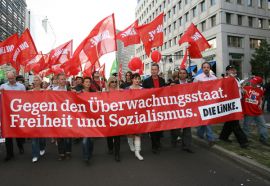
The 11.9% for the Left Party (Die Linke) does not look too impressive numerically, but it does signify the establishment of the party as a constant factor in Germany's political system. Considering that the party was only founded as a merger of East Germany's Party of Democratic Socialism (PDS) and West-German SPD dissidents in 2007, this is a remarkable achievement that indicates the desire for a left voice in the parliamentary arena.

At this point, the Left Party is the only party in opposition to the restoration of neoliberalism. It would also be the key point of coalescing if any further rightwing turn in German politics occurs. From this angle, the significance of the electoral boost of the Left Party lies less in increased presence in parliament. It lies in the stabilization of a political force that began, however vaguely, to advocate alternatives to neoliberalism at a time when that doctrine still seemed to be the only way of economic and social development. Whether the Left Party is ready to live up to these openings is an entirely different question. It is also possible that the party gets torn apart between the temptation of occupying government positions and building the base for independent working class political action, or even a wider rebellion.

These issues served as the basis for a roundtable discussion of Die Linke and the coming period of struggle in Germany over exit strategies to the financial crisis.

Click here to view the video and other useful resources.

Tuesday, 6 October 2009

Germany: Big gains for Die Linke as Social Democrats’ support collapses

via Links - International Journal of Socialist Renewal:

By Duroyan Fertl

October 5, 2009 – Germany’s ``centre-right’’ Chancellor Angela Merkel was returned to power in federal elections held on September 27, but with a record low voter turnout and an increased vote for the far-left party, Die Linke (The Left).

The election was a clear success for Merkel and her Christian Democratic Union (CDU). Her preferred coalition partner – the free-market fundamentalist Free Democratic Party (FDP) – increased its support by 4.8 per cent to an all-time high of 14.6 per cent, enough to form a CDU-FDP government. The FDP will now replace the CDU’s main rival – the ``centre-left’’ Social Democratic Party (SPD) – as coalition partner in the government of Europe’s largest economy.

At the same time, the SPD’s support collapsed by more than 6 million votes, dropping a massive11.2 per cent to only 23 per cent – its worst result since World War II. As one leading SPD member pointed out on election night, “We have been bombed back into the Weimar Republic”. SPD leader Walter Steinmeier described the result as “a bitter day” for German social democracy.

However, while the result has been widely characterised as a shift to the right, that view is not really borne out by the results. The total vote for the centre-right parties rose by only 3.4 per cent, while the vote for the neo-Nazi New Democratic Party (NPD) dropped to just over 1 per cent, while the total left vote dropped by only 5.4 per cent.

Voter turnout slumps

The election campaign was one of the dullest ever run, with the two major parties – CDU and SPD – being overly polite to each other, neither wanting to alienate voters or lose their chance of remaining in government.

In a televised “debate”, Steinmeier and Merkel acted like old chums, and the unofficial slogan of the entire campaign became “Yes we gähn” (“Yes we yawn”). As Dietmar Bartsch, Die Linke’s general secretary, explained: "It was a very boring affair. None of them were any good. It was exactly what we had expected."

After 11 years in government, presiding over increasing cuts to social welfare and rising poverty and unemployment, the SPD lost the confidence of many of its traditional supporters, and was barely able to distinguish its own neoliberal policies from those of its main rival during the election campaign.

The SPD’s support was also impacted by its refusal to consider going into coalition with the far-left Die Linke, making a vote for an SPD government essentially a vote for the status quo, and another “grand coalition” with the CDU.

Some disaffected SPD supporters shifted their votes to Die Linke or to the Greens, but millions simply stayed home, enjoying a last warm weekend before winter. In fact, the voter turnout was the worst in 60 years, down to 70.8 per cent from 77.7 per cent four years ago, and most of those voters were once SPD voters.

While the CDU managed to retain government, it also suffered a drop in its vote, down by 1.4 per cent to 33.8 per cent, also a record low. And while the CDU-FDP coalition won a slender majority in the Bundestag – the German parliament’s lower house – various left-wing parties still have a majority in the upper house (the Bundesrat),which is made up of representatives from state governments.

The new CDU-FDP government is expected to introduce widespread cuts to social spending, especially under the influence of the FDP. Although the more conservative CDU will temper the FDP’s neoliberal urges, the new government has promised to introduce tax cuts of up to 20 per cent, reduce public spending, reverse the phase out of nuclear reactors, increase the pension age to 67 and continue Germany’s military involvement in the occupation Afghanistan.

Die Linke

The real success stories of the elections were the minor parties. The big winner was the right-wing FDP, whose increased vote makes them the third-biggest party in parliament. The Greens also entered double figures for the first time in a federal election, with 10.7 per cent, and increasing its presence from 51 to 68 seats.

The far-left Die Linke – the newest party in Germany’s political landscape – won 10.9 per cent of the vote, an increase of 3.2 per cent on 2005. It is the first time in German history that a party to the left of the SPD has scored more than 10 per cent in an election. Die Linke’s representation in the Bundestag has increased from 54 to 76 MPs, 40 of whom are women.

Die Linke was formed in 2007 when the Party of Democratic Socialism (the successor to the former ruling Socialist Unity Party of the German Democratic Republic – ``East Germany’’) merged with the Electoral Alternative for Social Justice and Jobs (WASG) – a group of disillusioned SPD members, trade unionists and socialists formed in 2005 to oppose the right-wing policies of the SPD-Green coalition federal government of the time.

Since then. Die Linke has continued to increase in popularity despite a media scare campaign about the threat of “communism”. Die Linke’s election platform of improved social justice and public welfare, the introduction of a minimum wage, higher taxes for the rich, relaxing harsh unemployment laws and cutting greenhouse gases emissions by 90% by 2050 have resonated with an electorate suffering the effects of the economic crisis.

Unemployment is already more than 8 per cent and will continue to rise as Germany’s export-dependent economy tries to ride out the crisis. Well over 10 per cent of Germany’s population already lives below the poverty line.

While more than 80 per cent of the population is opposed to the war in Afghanistan, Die Linke is the only party calling for the removal of German troops.

In two years, Die Linke has now won seats in 10 of Germany’s 12 state parliaments. In the western state of Saarland, an SPD heartland and home to Die Linke spokesperson Oskar Lafontaine, the Die Linke won more than 21.3 percent of the vote in state elections in September, placing it just behind the SPD. In Bremen, Die Linke scored more than 14 per cent, and even in the conservative state of Bavaria Die Linke’s support more than doubled, reaching 6.5 per cent.

In the states of the former German Democratic Republic, Die Linke fared even better, becoming the second-biggest party in the region after the CDU, and well ahead of the SPD. Die Linke won more than 25 per cent support in a majority of eastern electorates, and leading members Gregor Gysi and Petra Pau won their seats in Berlin with nearly 50 per cent of the vote.

In state elections held on the same day as the federal poll, Die Linke also entered parliament for the first time in Schleswig-Holstein – winning 6 per cent of the vote and five seats in the legislature – while in the eastern state of Brandenburg, it received 27.2 per cent, just behind the SPD on 33 per cent.

Can the SPD move left?

The SPD’s disastrous results, and the increased support for Die Linke, mean the SPD leadership is under significant pressure to move the party to the left and work with Die Linke, or risk losing more support. Adding to that pressure, a recent survey found that more than 50 per cent of Germans think that socialism is a good idea, but had been badly applied.

Die Linke co-leaders Oskar Lafontaine and Gregor Gysi have both called upon the SPD to “re-social-democratise” in order to build a strong left-wing alliance against the new government. According to Die Linke’s deputy leader – and ex-SPD member – Klaus Ernst, if the SPD does not change “the last one out can turn off the light”.

This may not be as easy as time seems, however, as many SPD members still hold a visceral hatred for Lafontaine. As former chairperson of the SPD and former federal finance minister, Lafontaine is considered to be a “traitor” to the SPD. Lafontaine resigned from the SPD in 2005 in protest against anti-social policies of SPD Chancellor Gerhard Schroeder. He became a central leader of Die Linke, and an outspoken critic of both SPD policy and “finance capitalism” more generally.

So, while Die Linke has eclipsed the SPD in a number of state elections, and has indicated its willingness to enter coalitions with the SPD and the Greens to fight the looming attacks on public spending, in government as well as on the streets, it is unclear if the SPD will cooperate.

Only days after the federal election, the SPD in the eastern state of Thuringia refused to form a coalition with Die Linke – despite indicating it would do so during the election campaign. Although already in coalition with Die Linke in Berlin and Brandenburg, in Thuringia the SPD have chosen instead to work with the right-wing CDU.

There can be no guarantee, then, that the SPD will move quickly to the left or develop a coherent relationship with Die Linke, a situation which means that the social resistance to the new government’s spending cuts and reforms will be weakened.

Despite its significant gains, Die Linke is faced with a new series of challenges. As the clearest opposition voice and defender of social programs and public welfare, Die Linke must now find a way to relate to the millions of disillusioned SPD voters, and to organise the strongest possible response to the economic crisis and the pro-business policies of a right-wing government.

Monday, 8 June 2009

BNP wins 2 seats in Europe

Via Socialist Unity and Hope Not Hate:

Who is Andrew Brons?

Andrew Brons (left) in the 1970s campaigning with the National Front and BNP leader Nick GriffinYorkshire and Humber constituency will return Andrew Brons (at the left of the picture) to the European Parliament if the BNP gets 11.5% across the constituency. So far the results coming in show it to be on a knife edge.

The BNP have 10% in Sheffield, much more in Barnsley.

If they do win a seat there, we will have to deal with that situation as we come to it.

But I imagine there will be some fun and games inside the BNP is Griffin fails to be elected in the North West, which would give Andrew Brons a higher profile than the leader, and his own significant budget.

So who is Andrew Brons. Certainly if he is elected the press should give this Hitler lover some serious scrutiny.

Brons, 61, started his nazi career in the National Socialist Movement, an organisation that was deliberately founded on Hitler’s birthday by Colin Jordan, the British nazi leader who died in April aged 85. NSM members were responsible for an arson campaign against Jewish property and synagogues in the 1960s.

Brons appears to have approved. In a letter to Jordan’s wife, Brons reported meeting an NSM member who “mentioned such activities as bombing synagogues”. He declared: “On This subject I have a dual view, in that I realise that he is well intentioned, I feel that our public image may suffer considerable damage as a result of these activities. I am however open to correction on this point.”

He also sent Mrs Jordan money to buy a swastika badge and other Nazi material, explaining he was about the undertake a “crash programme” of publicity for the NSM in Yorkshire by deluging areas with Nazi stickers, posters and slogans.

Brons was a prominent member of the National Front, notorious for its extreme racism and violence, from its early days and was voted onto its national directorate in 1974. Later as the NF’s education officer he hosted seminars on racial nationalism and tried to give its racism a more “scientific” basis.

After the departure of John Tyndall from the NF in March 1980 Brons was promoted to NF chairman. One of his allies during this period was Richard Verrall, the author of Did Six Million Really Die?, with whom he edited the NF journal New Nation. In 1982 Brons led an NF march through Northfield on which marchers chanted: “we’ve got to get rid of the blacks”.

In June 1984 Brons was convicted of behaviour likely to cause a breach of the peace following his arrest in Leeds while selling papers in a shopping centre.

He and another NF member were heard shouting slogans such as “Death to Jews”, “White Power” and “National Front”. When approached by PC John Raj, Brons stated: “inferior beings like yourself probably do not understand the principle of free speech”.

Brons resigned as NF chairman in 1984 and later faded from public view. He has been a BNP member for around four years.

Monday, 25 May 2009

Wednesday, 22 April 2009

Colin Duffy to contest Euro elections

Regular readers of the Wombat Hole would be familiar with the name of Colin Duffy, the dissident northern Irish republican accused of involvement in the recent attacks in the six counties, and who went on hunger strike to protest his innocence and ongoing detention without charge, a detention which was ruled to have been illegal.

Well, it now appears that Duffy is set to stand as an independent candidate for the European elections, on June 4-7.

According to Ciaran Cunningham, a Belfast spokesman for "an umbrella organisation representing a number of dissident republican groups",[1] Republican Network for Unity:

"Colin Duffy intends to stand as a candidate in the upcoming European elections," he said.

"He will be standing on an end-28-day-detention ticket and an anti-internment ticket. A steering committee has been set up to direct the election campaign and RNU fully endorses that committee."

Naturally the Unionist spin-cycle has gone into hyper-drive accusing Duffy and his friends of "using this election as a personal and perverted referendum on a return to terror.” Whatevs...

Duffy, 41, currently faces eight charges
in relation to the attack on the Massereene barracks in Antrim on March 7th, an attack which the Real IRA has already taken responsibility for.

While there is little (well, stuff-all, really) chance of Duffy replicating the victories of the likes of Bernadette Devlin MacAliskey or hunger-strikers Bobby Sands and Kieran Doherty,[2] and win one of the three available seats, the Belfast Telegraph probably has it right when it points out that
"the campaign would highlight the introduction of 28-day detention under the Terrorism Act and could diminish Sinn Fein’s Bairbre de Brun’s prospects of topping the poll ahead of the DUP’s Diane Dodds."

For more (if not directly related) discussion of Norn Iron and what goes on there, see the ever-engaging Organised Rage, and the finger-on-the-bleeding-pulse reportage of Splintered Sunrise, as well as the bods over at éirígí and An Phoblacht.


[1]
Apparently this includes a large number of ex-POWs and ex-members of Sinn Fein, the 32 County Sovereignty Movement and the IRSP.
[2] While the Representation of the People Act of 1981 banned serving prisoners from running in elections in respnse to these victories, Duffy is on remand, rather than a convicted prisoner, and is still able to run.

Wednesday, 18 March 2009

Europe takes the world to the edge of the abyss

Via LeftBanker, a member of Scotland’s socialist party, the Scottish Socialist Party, and the FI, Fourth International.

Eastern Europe has borrowed $1.7 trillion abroad, much on short-term maturities. It must repay – or roll over – $400bn this year, equal to a third of the region’s GDP. This will be difficult because most lenders wish to rein in high risk debts and need the loans to supplement their diminishing capital.

Not even Russia can easily cover the $500bn dollar debts of its oligarchs while oil remains near $33 a barrel. The budget is based on Urals crude at $95. Russia has bled 36% of its foreign reserves since August 2008 defending the ruble.

In Poland, 60% of mortgages are in Swiss francs. The Polish zloty has just halved against the franc. Hungary, the Balkans, the Baltics, and Ukraine are all suffering variants of this story. As an act of collective folly – by lenders and borrowers – it matches America’s sub-prime debacle. There is a crucial difference, however. European banks have exposure to both while US banks are only exposed to the sub-prime market.
Almost all East bloc debts are owed to West Europe, especially Austrian, Swedish, Greek, Italian, and Belgian banks. Plus, European banks account for an astonishing 74% of the entire $4.9 trillion portfolio of loans to emerging markets.

They are five times more exposed to Eastern Europe than American or Japanese banks, and they are 50% more leveraged (IMF data).

Spain is up to its neck in Latin America, which has belatedly joined the slump (Mexico’s car output fell 51% in January, and Brazil lost 650,000 jobs in one month). Britain and Switzerland are up to their necks in Asia.
Whether it takes months, or just weeks, the world is going to discover that Europe’s financial system is sunk, and that there is no European Union (EU) Federal Reserve yet ready to act as a lender of last resort or to flood the markets with emergency stimulus.

The sums needed are beyond the limits of the IMF, which has already bailed out Hungary, Ukraine, Latvia, Belarus, Iceland, and Pakistan — and Turkey next — and is fast exhausting its own $200bn (€155bn) reserve. We are nearing the point where the IMF may have to print money for the world, using arcane powers to issue Special Drawing Rights. Its $16bn rescue of Ukraine has unraveled. The country — facing a 12% contraction in GDP after the collapse of steel prices — is hurtling towards default, leaving Unicredit, Raffeisen and ING in the lurch. Pakistan wants another $7.6bn. Latvia’s central bank governor has declared his economy “clinically dead” after it shrank 10.5% in the fourth quarter. Protesters have smashed the treasury and stormed parliament.

There are accidents waiting to happen across the region, but the EU institutions don’t have any framework for dealing with this. The day they decide not to save one of these countries will be the trigger for a massive crisis with contagion spreading into the EU.’ Europe is already in deeper trouble than the European Central Banks (ECB) or EU leaders ever expected. Germany contracted at an annual rate of 8.4% in the fourth quarter. If Deutsche Bank is correct, the economy will have shrunk by nearly 9% before the end of this year. This is the sort of level that stokes popular revolt. The German government passed legislation to allow them to nationalise their banks one week ago.
The implications are obvious. Berlin is not going to rescue Ireland, Spain, Greece and Portugal as the collapse of their credit bubbles leads to rising defaults, or rescue Italy by accepting plans for EU “union bonds” should the debt markets take fright at the rocketing trajectory of Italy’s public debt (hitting 112% of GDP next year, just revised up from 101%), or rescue Austria from its Habsburg adventurism.

This is why some people think the US dollar is going to remain strong over the coming months: because the rest of the world is falling apart even faster than the US.

Eastern Europe has borrowed an estimated $1.7 trillion, primarily from Western European banks. And much of Eastern Europe is already in a deep recession bordering on depression. A great deal of that $1.7 trillion is at risk, especially the portion that is in Swiss francs. It is a story that could easily be as big as the US sub-prime problem. Much of the lending is wait for it on speculative property based schemes!

In Poland, as an example, 60% of mortgages are in Swiss francs. When times are good and currencies are stable, it is nice to have a low-interest Swiss mortgage. And as a requirement for joining the euro currency union, Poland has been required to keep its currency stable against the euro. This gave borrowers comfort that they could borrow at low interest in francs or euros, rather than at much higher local rates.

But in an echo of teaser-rate sub-primes in the US, there is a problem. Along came the synchronized global recession and large Polish current-account trade deficits, which were three times those of the US in terms of GDP, just to give us some perspective. Of course, if you are not a reserve currency this is going to bring some pressure to bear. And it did. The Polish zloty has basically dropped in half compared to the Swiss franc. That means if you are a mortgage holder, your house payment just doubled. That same story is repeated all over the Baltics and Eastern Europe.

Austrian banks have lent $289 billion (230 billion euros) to Eastern Europe. That is 70% of Austrian GDP. Much of it is in Swiss francs they borrowed from Swiss banks. Even a 10% default rate (highly optimistic) would bankrupt the Austrian financial system, says the Austrian finance minister, Joseph Proll.

The problem is that in Europe there are many banks that are simply too big to save. The size of the banks in terms of the GDP of the country in which they are domiciled is all out of proportion. The US equivalent would be as if the bank bailout package were in excess of $14 trillion (give or take a few trillion). In essence, there are small countries which have very large banks (relatively speaking) that have gone outside their own borders to make loans and have done so at levels of leverage which are far in excess of the most leveraged US banks. The ability of the “host” countries to nationalize their banks is simply not there. They are going to have to have help from larger countries. But as we will see below, that help is problematical.

This has the potential to be a real crisis, far worse than in the US. Without concerted action on the part of the ECB and the European countries that are relatively strong, much of Europe could fall further into what would feel like a depression. There is a problem, though. Imagine being a politician in Germany, for instance. Your GDP is down by 8% last quarter. Unemployment is rising. Budgets are under pressure, as tax collections are down. And you are going to be asked to vote in favor of bailing out (pick a small country)? What will the voters who put you into office think?
However, getting all the parties to agree on what to do will take some serious leadership, which does not seem to be in evidence at this point. The US almost waited too long to respond to the crisis and they had the “luxury” of only needing to get a few people to agree as to the nature of the problems. And they had a central bank that could act decisively and quickly.

For the ECB to print money as the US and the UK (and much of the non-EU developed world) will do, takes agreement from all the member countries, and right now it appears the German and Dutch governments are resisting such an idea.

German finance minister Peer Steinbruck has said it would be intolerable to let fellow EMU members fall victim to the global financial crisis. “We have a number of countries in the eurozone that are clearly getting into trouble on their payments,” he said. “Ireland is in a very difficult situation.

“The euro-region treaties don’t foresee any help for insolvent states, but in reality the others would have to rescue those running into difficulty.”

Ireland is indeed in dire straits, and is particularly vulnerable as it is going to have to spend a serious percentage of its GDP on bailing out its banks and may need to raise taxes to help do so.

This is a new twist and manifestation of the global crisis of capitalism’s financial system; one that will almost certainly push Europe and the world into a prolonged deep recession. Or in other words a depression.

Monday, 23 February 2009

From Iceland to Ireland: the streets are rising...

With Iceland gone down the drain, and the Latvian government having collapsed only the day before, the greatest circus in the world continued to ramp up its act, with the Irish looking set to host the next crisis of a capitalist system give every impression of entering its death-throes.

*******
Also: An Phoblacht, éirigí, Socialist Party, this, this, and more
*******

Never a people to miss out on a party, up to 120,000 people took to the streets in Dublin last Saturday, surrounding the Dáil (Irish Parliament) and closing the Irish capital down. [Dublin – it should be pointed out, has a population of only 1.2 million, and the Republic of Éire only 4.7 million. This is easily the biggest protest since the Iraq war.]

The protest, organised by Ireland's chief union body, the Irish Congress of Trade Unions (ICTU), was directed against the Irish government's planned austerity measures, increasing unemployment and the ongoing bailouts of failing banks.

The most odious of these is a proposed "pension levy" on public sector workers, the centre-piece of the Irish government's economic recovery package.
The Irish economy - the "Celtic Tiger" - was once a poster pin-up of a neoliberal economy in the EU mould. Ireland slipped into recession last year, however, a situation made worse by a collapse in the important building and real estate sectors, and it's now looking more and more likely that the balloning budget deficit is going to hit 9.5% of Irish GDP by the end of the year. As a result, unemployment is exploding - a record 326,000 people were claiming unemployment benefits in January, and the number is likely to reach over 500,000 by the end of the year.

But that's not all.

On top of the job losses, the hip-pocket political suicide which is the "pension levy" [more on which below] and a recession so wide you could drive a revolution through it, Ireland is also wracked with outrage at what the bourgeois media calls "the handling" of Ireland's banking crisis, particularly the scandals seeping out of the Anglo Irish Bank, which was nationalised last month after collapsing under the weight of its own bad debts.

Anglo’s former chairman, Sean Fitzpatrick was forced out last year after it was revealed that he secretly took out 87 million euros worth of personal loans form the bank, and he clearly wasn’t the only bad apple in the barrel. There are already links being made or suggested between the bank's failure and people close to Irish Taoiseach (Prime Minister) Brian Cowen and the Fianna Fail government, including the Taoiseach himself.

So, to turn this all around, Cowen has cooked up a "levy" scheme aims to slug 350,000 public sector workers for between 1,500 euros and 2,800 euros (£2,500) each per year as the cost-cutting Cowen's finance-friendly response to the recession, in order to “save” about 1.4 billion euros (1.8 billion dollars) this year alone, with plans for
€15 billion in cuts over the next few years. And while Cunning Cowen talks of "saving" 15 billion euros to stabilise Irish finances, his government is busy pumping public funds into the banking sector, a fact which hasn’t escaped public scrutiny.

And there's the rub. In short: the government plans to recapitalise Allied Irish Banks and the Bank of Ireland by chucking €7 billion (that's about US$9 billion, about £6 billion, and something near AU$14 billion) into the fetid sinkhole of financial capitalism. Where's the cash coming from? Why, the National Pensions Reserve Fund, of course, a pretty package of cash (and a sovereign fund, to boot!) set up to pre-finance the pensions of public servants that retire after 2025. And what does Cunning Cowen do to fill the new financial black hole he's created? Why, he tries to make public servants pay a levy to recoup the costs. Brilliant!

The only problem apears to be that the Irish - despite the racist slurs and bigotry - ain't stupid, and they’ve just shown that in a 6-figure protest. And not the first, either, by all accounts.

ICTU leader David Begg said that the Dublin demonstration was "just the first step in a rolling campaign of action" to achieve a similar bringing to account of the country's bankers and politicians as the union-led protests that toppled the Icelandic government in January.

In fact, Begg apparently went further, calling for the nationalisation of the entire banking system, and ICTU president Patricia McKeown addressed the protest, ripping strips off the "casino capitalism that has brought this country to its knees.

"An economy cannot be built on shady financial deals, privatisation of public services and the ever insatiable greed of the very, very wealthy," she pointed out.

"But we face a government which wants the workers who built the economy to now sacrifice while it protects and bankrolls those who wrecked it. We are not prepared to live in that type of society," Ms McKeown declared.

So, the wombats raise our Waterford crystal glasses of whiskey and propose a health to the coming collapse of another stinking crooked government, and to the rise of people’s power, in Éire, Europe and across the world! Sláinte, agus beir bua!

Monday, 5 January 2009

France: From the Revolutionary Communist League to the New Anti-Capitalist Party

Contribution by LCR veterans, first published in International Viewpoint

Daniel Bensaïd, Alain Krivine, Pierre Rousset, François Sabado

This contribution was written as part of preparations for the January 2009 congress of the Revolutionary Communist League (LCR). The congress agenda includes the political “self-dissolution” of the LCR, to set the stage for the new challenge of the New Anti-Capitalist Party (NPA). The authors of this piece belong to the generation of activists from the 1960s and 1970s; so while principally addressed to members of the LCR, it may be of interest to many others.

by H. Adam, D. Bensaid, F. Coustal, L. Crémieux, J. Guillotin, S. Johsua, A. Krivine, O. Martin, C. Poupin, P. Rousset, F. Sabado, R. Vachetta

For 20, 30 or 40 years now, we have built the LCR.

Today, we are fully part of the constituent process leading to the launch of the NPA. We approach this new enterprise with confidence thanks to – and not in spite of – what the LCR has accomplished over these past few decades. This is a momentous development; the LCR’s decision to dissolve itself in order to take up a broader challenge is a rather exceptional event in the history of the French working-class movement.

We are able to take this gamble because we are not beginning from scratch. It is no accident that — of all the groups within the French and even international revolutionary Left – it is the LCR that has taken such an initiative. We are the product of a particular history of the revolutionary movement – the fusion of a current of Trotskyism with the youth radicalization of the 1960s. We are a non-dogmatic current of revolutionary Marxism that has been able to preserve fundamental elements of continuity in the history of the working-class movement, particularly in relation to Social Democracy and Stalinism. These include the defence of a program of demands that are both immediate and transitional towards socialism; a united-front policy that aims for mass mobilization of workers and their organizations; a policy of working-class unity and independence against any type of strategic alliance with the national bourgeoisie; opposition to any participation in governments in the advanced-capitalist countries that merely manage the State and the capitalist economy; and unfailing internationalism.

Unlike other currents, we have endeavoured to incorporate a wide range of new factors into our political tradition: the post-war evolution of capitalism; active solidarity with the anti-colonial revolutions and with the anti-bureaucratic movements in the Eastern bloc; an analysis of the new social movements such as the women’s movement and, today, growing eco-socialist awareness in the face of the ecological crisis; and, above all, ongoing examination and enrichment of one of the key points of our program, socialist democracy.

This is a trademark of the LCR. The LCR has been able to ensure the continuity of the Left Opposition’s struggle against Stalinism. What is more, unlike most currents of the revolutionary Left in France and in a whole host of countries, it has also upheld the principles and practical application of democratic and pluralistic organization and functioning. Throughout its history, taken together, our sensitivity to this question and our democratic and pluralistic internal functioning have enabled the LCR to provide a home for a series of currents and organizations with different origins and political cultures. And it has meant that the LCR is now in a position to build something with other forces and to embrace the new challenge of the NPA.

The NPA is the result of the political work of recent years, especially of our contribution to the renewal of the social movements and of the success of the presidential campaigns of 2002 and 2007 around Olivier Besancenot. But the idea goes back much further than that.

Beginning in the early 1990s, the collapse of the USSR and of the Eastern-bloc countries, combined with neo-liberal capitalist globalization, brought one historical cycle to a close and opened another. “New epoch, new program, new party”: this was a three-pronged approach towards thinking about the new historical period. Political action would be framed by a new set of parameters. It would henceforth be possible to overcome the divisions that had separated the many revolutionary and anti-capitalist currents born in the 19th and 20th centuries.

Of course, we were uncertain about the new organizational forms, characteristics, limits and dynamics. But the question was posed, on both the international and national level. Internationally, we took initiatives through international conferences and went through a number of experiences, each with its own specificities: the PSOL in Brazil, after the experience of the PT; Sinistra Critica in Italy, after the experience of Rifondazione Comunista; Respect in Great Britain and the Scottish SSP, before the splits in these two organizations; the Left Bloc in Portugal; and the Red-Green Alliance in Denmark.

In each one of these processes, some questions were settled – especially around the matter of the relationship with political power and participation or not in centre-Left and social-liberal governments. These questions led to the split of PSOL from the PT and Sinistra Critica from Rifondazione Comunista. They also underlie our differences with the leadership of Die Linke in Germany, which has declared its support for parliamentary and governmental alliances with Social Democracy.

The NPA will be clearly defined politically. Its preliminary documents set out some unmistakable terms: class struggle and support for all the struggles of the exploited and oppressed; unity in action of workers and their organizations; a break with the capitalist system; an eco-socialist project; opposition to any policy of managing the capitalist economy and the central executive powers of capitalist institutions; the struggle for a workers’ government; the revolutionary transformation of society; socialist democracy; and an internationalist program and practice. To be sure, a number of questions will remain open: the nature of revolutions in the 21st century; problems of the transition to socialism; and a whole range of other questions having to do with the reformulation of the socialist and communist project. But we are not beginning from scratch; and the NPA will collectively determine its own positions on the basis of new common experiences.

It is therefore not a matter of building a revamped LCR. We don’t only want to build a broader party; we want to build a party that is a new social and political reality. It will be pluralistic. It will take the best of all the revolutionary traditions of the working-class movement and of other movements such as eco-socialism. Its goal is to bring all anti-capitalists under one roof.

The NPA will be an internationalist organization, in charge of its own policies on international matters. It will not be a section of the Fourth International (which is a specific international political current). As a pluralistic party, the NPA cannot join the Fourth International (FI) as such. The process of building a new International – which has always been and remains our goal – will be long and complicated. The building of anti-capitalist formations in individual countries will not take place in synch with the building of a new international grouping. As allowed for by its statutes, we remain members of the FI, with ties to the LCR comrades elected to its leadership bodies. Given the role the LCR plays within the International, we have proposed that the NPA continue to shoulder a number of tasks for which the LCR was responsible within the FI.

We are also proud to have passed on to a new generation not only a part of our political heritage but also the full range of leadership responsibilities – without the turmoil and crises of succession that most parties experience. Credit for this goes equally to the older generation, the youth and those somewhere in between. As the LCR dissolves into the NPA, though, we make a specific appeal to the sense of responsibility of LCR members. Their experience and training are vital to the building of the NPA. They are among the preconditions for the new party’s success, and for the successful synthesis of new and old. Everyone should get fully involved, as we have decided to do ourselves. Without a doubt, this will be a remarkable exercise in learning to speak with broader sectors, in paying special attention to the vocabulary we use, in learning to listen to and respect others, and in learning from them without underestimating what we bring to them ourselves. After the NPA founding conference, every comrade from the LCR should get involved in building this new project, for which we have fought for so many decades.

15 December 2008

Translation: Raghu Krishnan

-Daniel Bensaïd is one of France’s most prominent Marxist philosophers and has written extensively. He is a leading member of the LCR (French section of the Fourth International).

-Alain Krivine is one of the main spokespersons of the French Ligue Communiste Revolutionnaire

-Pierre Rousset is a member of Europe Solidaire Sans Frontiers (ESSF). He has been involved for many years in Asian solidarity movements

-François Sabado is a member of the Executive Bureau of the Fourth International and of the National Leadership of the Revolutionary Communist League (LCR, French section of the Fourth International).

Sunday, 21 December 2008

Greece: the struggle continues

by Panos Garganas (Socialist Worker, December 15, 2008)

The anger that exploded in Greece following the police killing of 15 year old Alexandros Grigoropoulos is still raging.

Workers’ strikes, student occupations, walkouts by school students, mass demonstrations and clashes with the police are intensifying the pressure on the right wing New Democracy government.

The shooting of Alexandros on Saturday 6 December has become a focus for all the discontent in Greek society – over job cuts, low wages and lack of opportunities.

Instead of dying down, as the government had hoped, the revolt has instead taken on a more organised form.

Teachers struck on Tuesday of last week over the killing, as Alexandros’s funeral took place. Thousands of school students also demonstrated.

A general strike of workers over the government’s austerity budget plans shook the country the following day.

Trade union leaders cancelled a march that was to take place in the centre of Athens and held a rally instead. But the Anti-Capitalist Left coalition went ahead with the march.

And it was massive – with several thousand joining it. The march reinforced the feeling that it is possible to act and to demonstrate – and that we will not let the police teargas us off the streets.

Many students refused to go to school the next day. They marched to the local police stations and attacked them.

When the police fought back, local people intervened on the side of the students to help chase the police away.

A coordinating meeting of university students has called for a day of action and national demonstration on Thursday of this week. It also urged the unions to call a new strike.

Hospital workers are already planning to strike on that day against cuts and privatisation, and the teachers’ union is also expected to join the action.

The Greek TUC has called a demonstration outside parliament for Friday of this week, as that is the day of the budget debate.

The following day there will be an anti-racist demonstration against recent attacks on Pakistani immigrants.

While things may calm down over the Christmas period as schools and universities are closed, there are signs that the movement will re-emerge in the new year.

There is already a day of action planned for 12 January, when teachers will commemorate a colleague killed by right wing thugs during a wave of industrial action in 1991. The day will also now be used to remember Alexandros.

The revolt has intensified the government’s crisis. Its support is plummeting, with polls showing it trailing the centre left Pasok by 5 to 7 percent.

But the parliamentary left is in disarray. The Anti-Capitalist Left has argued that the riots should turn into an organised movement that could then overthrow the government.

The first part of this has happened. Now many people are pushing for the second part to take place.

There is a massive feeling in society that the government must go. So there is a big opportunity for the radical left—and we are trying our best to grasp it.

The solidarity protests across the world have shown us that we are not alone. People around the world should continue to stand with the uprising in Greece.

Tuesday, 16 December 2008

Greece: Left prospects in the post-PASOK era

By Michalis Spourdalakis

In the last few years, the political alignments in the European Union (EU) countries have changed drastically. In the 1990s, social-democratic parties and centre-left political forces were dominant. Under the banners of “progressive governance” or “modernisation” these parties ruled numerous countries and dominated the political scene on the continent.

Today, it is no secret that after long years in government, these political forces, what some like to call the “governmental left” are, to say the least, in retreat. It is indeed no secret that social democracy is in deep crisis: the recent congress of the French Socialists proved that this party is going through a period of self-questioning over the issue of its leadership, but also that it had nothing new to offer or, as a conservative daily commented, it appears as if “it does not think any more”.

In Germany the situation is even worse as the social-democratic party, the SPD, is displaying an unprecedented obsession over the personalities of its leadership. In the UK, George Brown and his Labour Party resemble more and more John Major’s Conservatives just before their devastating defeat in 1997. In Italy, after its defeat by the right-wing Forza Italia of Silvio Berlusconi, the Democratic Party has turned into a real Babel, which has completely paralysed its capacity to oppose the government’s often reactionary policies.

This trend, with the possible exemption of Spain under the prime ministership of Jose Zapatero of the Socialist Party, is clear and the conclusion rather obvious. The “third way” of the “governmental left” has led to a turn to the right. The rejection of the so-called European Constitution in the French and the Dutch referendums in 2005, and even the recent Irish rejection of the latest version of the new neoliberal EU Constitutional Treaty (Lisbon Treaty), did not slow down the deepening of social-democratic crisis. In fact, the gap created by the decay of the reformist left has brought to the fore the need to resist right-wing policies and hegemony. This has energised once dormant attempts to mobilise the radical left and has generated initiatives towards the mobilisation of those political forces on the left that do not subscribe to the conformism of “new social democracy”. Die Linke in Germany and the Bloco de Esquerda (Left Bloc) in Portugal seem to be the most prominent and successful examples of the rising new left forces on the European scene.

Situation in Greece

The situation in Greece is no exception to this pattern. In fact, as recent developments have shown, the “Greek case” could provide a good example for the direction of the left and leftists where the local social democratic, centre-left, or labour parties are incapable of resisting right wing aggression and have definitely abandoned any intention of or even promise for the structural transformation of the society.

Indeed, PASOK (the Pan-Hellenic Socialist Movement) dominated the Greek political scene for 11 consecutive years, most of it under the banner of aggressive “modernisation”. It was then followed by two consecutive victories of the right-wing New Democracy (ND) party. But today, with its modest but hopeful performance in last year’s election (5%), the radical independent left, under the name the Coalition of Radical Left -- SYRIZA, is expected to at least double its electoral support in the next election. The sudden explosion of the influence of the left in Greece becomes even a greater surprise when one considers that the Communist Party of Greece (KKE) commands 8 per cent of the popular vote. What has happened? Under what conditions is the radical left in Greece about to make a major breakthrough? Before we look at these questions, let us briefly turn to the developments of the Greek left after the fall of the Junta (1974).

Charting the Greek left

1974 was the turning point not only for the Greek left but also for the overall politics of the country. After some three decades of a restricted democratic regime and a seven-year dictatorship, a genuine transition to democracy was inaugurated. This gave the left, in both its social-democratic and communist form, a chance to develop freely. Thus, on the one hand, Greece had the creation of the Pan-hellenic Socialist Movement (PASOK) and, on the other, the legalisation of the parties of communist origin and orientation.

PASOK’s “socialism”, a mixture of populist radicalism and Keynesian reformism, was far from a class-based politics, without at the same time excluding those who subscribed to the latter. In the context of the post-dictatorship radical environment, PASOK, thanks also to its charismatic leader Andreas Papandreou, gave the impression that it was not only further to the left than its European counterparts but even more radical than the country’s communists. In the 1980s, PASOK came to power and were nothing more than a typical example of mainstream social democracy at the time. This reformism was enough, however, to co-opt a large segment of the traditional left’s social base. After a short interlude away from government, PASOK regained power in 1993, but the new PASOK –- especially after 1996, under the leadership of K. Simitis, a firm proponent of modernisation –- bore no resemblance to its radical foundation. The new PASOK, which dominated the country’s politics until its defeat in 2004, was very close to the politics of Tony Blair’s New Labour and in tune with the new governmentalist European social democracy.

On the other side of the left spectrum, the KKE, even after the collapse of the regimes of Soviet-inspired communism, is a typical party of the Third International tradition. It is the heir to the ``glorious party'' that led the resistance during the Second World War and was defeated during the civil war that followed. During the Junta years it underwent a major crisis and split into the KKE and the KKE-Interior (1968). The former dominated communist politics and the latter developed as a Eurocommunist party. In 1988, the two parties of the communist left and a number of other independent socialists formed Synaspismos (the Coalition of the Left and Progress -– SYN). Three years later the KKE left SYN, which in effect led to another split of the KKE since almost half of is central committee and thousands of its members remained in SYN. The KKE maintains a strong stand against the EU and its discourse is often simplistic and anthropomorphic. To the KKE, all other parties, including SYN, are the same since they all promote capitalism and reproduce the system, which provides it with the excuse to rule out any possibility for co-operation and legitimises its segregationist strategy, even in the trade union movement. At the same time, as the problems of the economy and in the Balkans mounted, the KKE’s anti-imperialist stand often gets sidetracked into populist xenophobia and nationalism.\

SYRIZA

In 2000, at the height of PASOK’s modernising project, a number of small leftist extra-parliamentary organisations, groups and networks as well as a number of independent activists formed the Coalition of Radical Left -- SYRIZA. The coalition was an initiative of SYN, which was struggling to meet the threshold of 3 per cent required to enter the parliament. As could have been expected, SYN became the backbone of SYRIZA. In 2004, a former member of KKE and a European MEP (member of the European Parliament) for many years, Alekos Alavanos, took over the leadership of SYN and crafted a strategy to strengthen SYRIZA. SYRIZA would have to become the unifying agency of the entire left –- a presence so strong that it would no longer feel squeezed between the PASOK’s conformist governmentalism and KKE dogmatism. Support for this project had to come from the labour and social movements that the new leadership actively tried to strengthen by forming ties with them. The strategy was founded on the principle of “empowering the powerless”. It evolved through giving increased opportunities for positions to the party’s young members, something rather unusual for the communist origin left.

The much criticised choice of Alexis Tsipras, then a 32-year-old engineer, to stand as the party’s candidate for mayor in Athens in the fall of 2006 municipal elections is a very good example of SYN’s new spirit. The success of this initiative (Tsipras won an unprecedented 10.5 per cent of the popular vote) strengthened and stabilised the party’s new strategy. However, the real political impact of this strategy was demonstrated during the 2006-7 mobilisation of students against the constitutional amendment that would allow the establishment of universities by the private sector. SYN was pivotal in changing public opinion to such an extent that PASOK was forced to change its position on the issue, a development that annulled the Government’s efforts on the issue.

More importantly, SYN’s strategy on this and other issues seems to be breaking away from instrumentalism vis-à-vis the power structure, as was traditionally denoted by the strategy and the tactics of the left. This was an instrumentalism that revealed a formalistic perception of political power expressed either when the left-wing movements and parties are completely preoccupied with their presence in public office; or when they separate their mobilisation initiatives from the societal base through the functioning of the state institutions. By mid-2007, it was becoming clear that SYN, along with its front organisation SYRIZA, was much more confident about the outcome of the upcoming elections.

The result of the 2007 September election was not a surprise. SYRIZA won 5 per cent of the popular vote and 14 seats in the 300-seat parliament, and the KKE an impressive 8.1 per cent and 22 seats. PASOK experienced its second consecutive defeat by a further loss of 2.5 percentage points and started to display signs of fatigue and a political inability to mobilise effectively. The slim parliamentary majority (by only two seats) of New Democracy and the entrance of an ultra-right party into the parliament, in combination with the leadership crisis of PASOK, elevated SYRIZA to the prime opposition force to the government. In February 2008, SYN held its fifth congress, where Tsipras was elected as party leader. He thus replaced Alavanos, who remains however the leader of the SYRIZA. Since the election, SYRIZA has displayed a steady increase in its popularity. In fact for more than half a year, all the public opinion polls show that the party has more than doubled its popular support.

Conditions ripe for hope on the left

Clearly the developments noted above cannot be taken as proof of a turn of Greek society to the left. This is not simply due to the pessimism of left intellectuals. It is because the turning of a society to the left is a rather complicated process that cannot simply be detected through conjunctural electoral gains. It has more to do with the change in the balance of social powers and radical changes in the society’s values to such an extent that realistically result in the building of counter hegemonic structures.

However, although it is obvious that the dynamic of SYRIZA on the Greek political scene does not prove we are witnessing a general turn of the society leftwards, at the same time it is more than clear that the Greek left has drawn upon certain important social developments that characterise advanced capitalist societies. These developments have created a conducive environment for the Greek radical left to make a major breakthrough and to reshape the balance of power in the country. This will be so as long as its leadership and its political organisations continue to see these as new openings, and insist on capitalising on them in a creative fashion as they have done in the last couple of years.

This is not the place to elaborate extensively on the overall developments that have facilitated the prospects of the Greek left wing making advances a realistic and even short-term goal. However it is worth highlighting three wider European developments.

First, the impact of various applications of the strategy of neoliberalism for the restructuring capitalism in the last three decades has radically shaken the long lasting belief that the young generations could realistically hope to have a better and more prosperous life than their parents. The years of security and of improved real incomes seems to belong to the past. Even Eurobureaucrats and the political elites openly admit that the maximum the EU countries can hope for is to introduce policies in order to manage the social issues in a way that there are not going to result in major social shake-ups. The debate on “flexicurity” across Europe is a good case in point.

Second, the frequent alternation in power between right-wing, conservative or Christian-democratic and reformist social-democratic parties in power in the European countries has generated a political cynicism that has forced large numbers of citizens to seek their political representation elsewhere. The mobilisations around the European Social Forum and other campaigns and movements, which were not so much part of the political tradition of Europe as they were part of the tradition in North America, are good examples.

Third, the combination of the above two developments, along with the liberating effect of the collapse of the “actually existing socialism” and the end of the “Cold War” has widened the audience for the radical left.

In addition to this situation, which seems to be more or less common to most EU countries, the Greek case displays several additional traits that have had a positive impact on the left’s recent positive dynamic.

Opposition to `reforms'

First, for the last five years, the right-wing government has introduced a number of what it calls “reforms” that have generated tremendous social reactions. These “reforms” are justified as necessary in order to deal with PASOK’s governmental errors. But they have resulted in policies whose origin and philosophy can in fact easily be attributed to the PASOK modernisers. This strategy is part of the government’s tactics of “blaming everything on PASOK”. Along with PASOK’s internal rivalries over its leadership, the parliamentary scene gives wide space for SYRIZA’s intention to express social discontent -– it is a realistic and viable project. Indeed, SYRIZA was the only political force to challenge the government’s incomes policies and bring to the fore the issue of what it calls the “700 Euro generation” (the ``G700'' generation of young Greeks between ages 25 and 35 who make 700 euro a month and are overworked, underpaid, debt ridden and insecure) to play a key role to hamper the government plans to privatise universities and to mobilise against the reforms in country’s pension plans system. On all these issues, SYRIZA’s political action was innovative. It adopted a fresh discourse which, although remaining within its overall strategy for the unity of country’s left, managed to demarcate itself from PASOK without at the same time sliding into the alienating simplistic logic of KKE that wants to equate PASOK with the ND.

Second, although part of PASOK’s defeat can be attributed to widespread phenomena of corruption during its terms in government, it did not take long for the ND government to elevate corruption and the mismanagement of public funds to a real art. This phenomenon further contributed to an extensive disenchantment with the two government parties of the country or with what it called “system of bipartism”. As this disenchantment has also been expressed in anti-party, anti-collectivist and apolitical attitudes, SYRIZA’s effective opposition strategy has managed at least to stop this trend from spreading.

Third, EU policies have, in the last few years, become more and more reactionary. The great alliance in the early 1990s formed around the axis between the French socialists and the German Christian democracy, which managed to somehow to protect the EU from Thatcherism, has long collapsed. Instead the phenomena of complete submission of the EU’s policies to finance capital and the market are far too frequent. The latest decision of the Council of Ministers to extend maximum working hours to 60-65 per week, the complete deregulation/privatisation of the energy sector, the increase in interest rates, which contributes to the phenomena of recession and the recent policies on immigration that intend to “fortify” the EU against the invasion of immigrants -– all highlight the political direction of the EU.

SYRIZA once again has been the only political force in the country that can legitimately challenge these policies. As PASOK and ND offer their unconditional support to the EU initiatives and KKE has always been a dogmatic Eurosceptic, SYRIZA, with its pro-EU background can now convincingly challenge these policies and promote a well-grounded vision of a socialist EU along with the parties that participate in the Party of the European Left.

Finally, another very positive factor contributing to the advancement of the radical left is the fact that neither PASOK nor ND and even less so KKE have renewed their political personnel. This phenomenon has contributed to the anti-political and anti-party sentiment of the population. At the same time the fresh and young leadership -– both in style and in age -– of SYRIZA creates an obvious comparative advantage. This point may sound rather superficial, however, in the age of electronic media, such phenomena cannot be considered insignificant.

Challenges ahead

The above presentation of all the positive elements in the socio-political environment of the Greek radical left, may have led the reader to picture the future in rather rosy hues. One should not rush to conclusions. There are still a number of serious dangers and challenges in the future prospects and the dynamics of SYRIZA and the Greek left in general.

The major dangers for the building of a new Greek left derive from an over-anticipation of the rapid success of its strategy. This may lead its often young and/or inexperienced leadership, and even its membership, to strengthen its understanding of politics as a public relations project. It would not be so difficult for something like this to happen under the present conditions of “media-driven politics”. This, in turn, may shrink its ambitious strategy to focusing on success at the polls. Winning elections is part of the project but an obsession with elections can lead to a paralysing and short-sighted electoralism.

Furthermore, the international and domestic social and political dynamics have generated so many pressing contradictions that they have made SYRIZA’s opposition and mobilisation efforts an easy affair. This ease may result in the creation of an anti-neoliberal but not anti-capitalist political party. Such a development could lead to the absurdity of a “left-wing party without socialism”. Signs of the latter can already be seen in Die Linke in Germany and they may spread to its Greek counterpart, given their close collaboration within the Party of the European Left.

In addition to these dangers, the Greek left is faced with a number of other important challenges. Key among them is how to transform its political, electoral advances into social gains. How, in other words, can it convincingly demonstrate that the problems faced today are structural by-products of the system and not simply side-effects that can be treated through some kind of reforms? To put it crudely: how can it prove that reformism is probably the most illusionary idea of our times?

All these dangers and challenges can be confronted if SYRIZA manages to put forward a comprehensive plan for party building that can capitalise on the experience both of its origin and of the new social movements. It needs to be an organisation that would respect our society’s social division of labour between parties and other movements and capitalise on the new technology of political mobilisation. This social project, in addition to everything else, is about an organisation, a political party. For, it is our organised collectivity that is not only the cornerstone of our current struggles, but also a small-scale model of the society of tomorrow about which we dream.

[Michalis Spourdalakis teaches political science at the University of Athens, Greece. This article first appeared in the October-December, 2008, edition of Relay, magazine of the Socialist Project (Canada), and has been posted at Links International Journal of Socialist Renewal with permission. It was written before the latest youth uprising throughout Greece.]

Friday, 12 December 2008

Left unity - at what cost?


Parti Socialiste leader Mélenchon aims to be new Mitterrand, writes Jean-Michel Edwin

Weekly Worker, December 4

With so much happening in French politics, it is easy to believe that the left is on the move. But appearances can be deceptive.

Take the Parti Socialiste. Its left wing is now completely marginalised and the party is deeply divided between two rightwing factions. One is led by last year’s presidential candidate, Ségolène Royal, and the other by Martine Aubry, the minister of social affairs under the government of Lionel Jospin who was responsible for introducing the 35-hour week. Her last-minute, purely opportunist coalition with what remains of Benoît Hamon’s ‘socialist left’ was just enough to see her elected PS leader last week. At the end of the day, Aubry scraped home with a majority of one hundred votes in a party of 200,000 members. After initially disputing the result, Ségolène Royal accepted her defeat - only to immediately launch her own presidential election campaign for 2012, whether Aubry liked it or not!

The well-known leaders of the PS left, Jean-Luc Mélenchon and Marc Dolez, had, of course, just walked out of the party - leaving poor old Benoît Hamon virtually alone on the PS left - to launch their own Parti de Gauche (Left Party) modelled on - and with the active support of - Oskar Lafontaine’s Die Linke in Germany.

On Saturday November 29 the Parti de Gauche was launched with a mass rally outside Paris in front of 1,500 enthusiastic supporters - Lafontaine himself was a star speaker. Mélenchon had just achieved an important success the week before when he won the leadership of the Parti Communiste Français to his project for a ‘left front’ for next June’s European Union elections. The PCF officially signed the agreement with senator Mélenchon just before its own congress, which will take place from December 11 to 14. This had the effect of pre-empting the congress decision on electoral strategy - delegates will be expected to applaud rather than endorse the alliance with Mélenchon.

His Parti de Gauche will have its founding congress in February 2009 - just a week after another new party - Olivier Besancenot’s Nouveau Parti Anticapitaliste (NPA) - is born. But the rightwing minority in comrade Besancenot’s Ligue Communiste Révolutionnaire is already looking in Mélenchon’s direction, and the self-proclaimed leader of the French left will know how to exert the maximum pressure on the NPA before its congress: ‘If you refuse to sign up to the left front for the EU elections and decide to run your own anti-capitalist list instead, guess what will happen next week? How about a quick split the week after your NPA is founded?’

There is nothing improvised about the Mélenchon operation. It is crystal-clear that the whole thing has been planned down to the last detail.

Mélenchon’s strategy

The NPA project for a ‘do it yourself’ party has been built in a confused, yet mostly democratic manner, and has met with real success: not only has Olivier Besancenot personally registered impressive scores in pre-election opinion polls - a recent one for the most popular leader of the left placed him first, with 40% support - but the NPA may well start in January with 12,000 members or even more.

In marked contrast to the steady, democratic party-building process of the NPA, Mélenchon’s Parti de Gauche has been launched like a French version (on a much bigger scale, of course) of Arthur Scargill’s Socialist Labour Party in Britain: here is the leader, with his ready-made programme; all you need do is join now and he will tell you what you have to do next. That is the senator’s method. Mélenchon’s party is anything but a democratic project.

How about the Parti de Gauche’s - I mean Mélenchon’s - aims and strategy? No doubt there either! Mélenchon wants to be in the French government - and soon. That will, in all likelihood, mean a coalition with the PS, and it goes without saying that the Parti de Gauche will be a junior partner.

But Mélenchon is dreaming of bigger things. The 2009 EU elections are seen by him as a fantastic window of opportunity. A space will open up for a very short moment in June, when Nicolas Sarkozy’s party, the Union pour un Mouvement Populaire, is expected to still be in a bad state, when the divided PS will not be seen as an acceptable alternative by French electors and when the new rising star of the far right, Marine Le Pen, daughter of Jean-Marie, will not have had enough time to rebuild her Front National on its new, better packaged and more populist basis (despite the best efforts of the new FN ideologue, the former PCF member and ‘Marxist’ writer, Alain Soral).

Into the vacuum will step the left front led by Mélenchon - if it is broad enough (from the NPA to all kinds of left nationalists), with its relative majority - ie, the largest share of the vote - in the June elections. To continue the fantasy, Mélenchon will then have three years to become leader of a new mass party, incorporating the PS and PCF - the new François Mitterrand.

This strategy requires the manoeuvring associated with Bonaparte’s military tactics - ‘concentrate your forces in the right place and then attack’. Mélenchon will first aim either to integrate the NPA into his project or neutralise it fast. In order to achieve this, Mélenchon is using left-sounding, but openly reformist and nationalist rhetoric: “Let us assemble in our country a new political majority of the left in order to govern,” he urged those who attended the November 29 rally.

Clarification

However, his sudden rise to prominence may prove to be a positive help in clarifying the dividing lines on the far left.

First of all, there is the Parti Ouvrier Indépendant, the new ‘broad party’ set up in June by the Lambertist Parti des Travailleurs. The PT had been France’s largest Trotskyist grouping, but has now dissolved itself into the left-nationalist POI, which claims 13,000 members. Despite its size, however, the POI is completely isolated because of its ultra-sectarian method, inherited from the PT. Yet it promptly applauded Mélenchon’s move - so what will happen if the POI decides to join the Parti de Gauche, either as an open faction or as deep entrists?

More importantly, what will be the impact of Mélenchon’s new party on the NPA? Christian Piquet, leader of the rightwing LCR tendency, Unir, has made it clear where he sees the NPA’s future: “After the Communist Party opened up the possibility with its national council resolution (which we immediately welcomed), the Parti de Gauche has today proposed an inclusive left front … open to all political forces wishing to take part, up to and including Lutte Ouvrière and the Parti Ouvrier Indépendant.”

Unir also welcomes Mélenchon’s view of how the alliance should develop: “Form a front and then see what is possible - rather than proclaim the necessity of total political, ideological and organisational convergence before getting down to work.” In other words, Unir agrees with Mélenchon that the left (very broadly defined) should unite for unity’s sake - in practice for the sake of getting him elected.

Unir talks about a “political dynamic” in favour of what it calls the entire “transformation left” coming together for the EU election and demands that the NPA steering committee immediately discuss the matter. The opportunity is too important to miss, “beginning with the NPA”, said Picquet, taking advantage of the confusion that exists within the NPA and the LCR itself. The weak point in the NPA project - which Mélenchon and his lieutenant, Piquet, have put their finger on - is the absence of any real strategic perspective: a new working class, anti-capitalist party, sure. But for what? France needs a left government now, doesn’t it?

The left majority in both the LCR and the NPA committees have decided that the party they will found will not take part in any reformist government - even one that calls itself ‘anti-neoliberal’ (although, with the rediscovery of Keynes, you could say that we are all anti-neoliberal now). The LCR continues to promote the classical ‘transitional’ alternative of a ‘workers’ government’ based on a radical ‘emergency platform’, which will be unacceptable to the bourgeoisie. In this scenario, a radical new party posing such an alternative will soon be faced with a choice - either build soviets everywhere in France … or accept the more realistic proposal of a left front headed by Mélenchon.

We Marxists have a different vision: the long, patient work necessary to create a mass party of opposition to the system, based on working class independence, extreme democracy and proletarian internationalism. The NPA must be part of the process to create such a party.

Friday, 5 December 2008

Socialism's comeback

At the beginning of the century, the chances of socialism making a return looked close to zero. Yet now, all around Europe, the red flag is flying again, writes Neil Clark in The New Statesman

"If socialism signifies a political and economic system in which the government controls a large part of the economy and redistributes wealth to produce social equality, then I think it is safe to say the likelihood of its making a comeback any time in the next generation is close to zero," wrote Francis Fukuyama, author of The End of History, in Time magazine in 2000.

He should take a trip around Europe today.

Make no mistake, socialism - pure, unadulterated socialism, an ideology that was taken for dead by liberal capitalists - is making a strong comeback. Across the continent, there is a definite trend in which long-established parties of the centre left that bought in to globalisation and neoliberalism are seeing their electoral dominance challenged by unequivocally socialist parties which have not.

The parties in question offer policies which mark a clean break from the Thatcherist agenda that many of Europe's centre-left parties have embraced over the past 20 years. They advocate renationalisation of privatised state enterprises and a halt to further liberalisation of the public sector. They call for new wealth taxes to be imposed and for a radical redistribution of wealth. They defend the welfare state and the rights of all citizens to a decent pension and free health care. They strongly oppose war - and any further expansion of Nato.

Most fundamentally of all, they challenge an economic system in which the interests of ordinary working people are subordinated to those of capital.

Nowhere is this new leftward trend more apparent than in Germany, home to the meteoric rise of Die Linke ("The Left"), a political grouping formed only 18 months ago - and co-led by the veteran socialist "Red" Oskar Lafontaine, a long-standing scourge of big business. The party, already the main opposition to the Christian Democrats in eastern Germany, has made significant inroads into the vote for the Social Democratic Party (SPD) in elections to western parliaments this year, gaining representation in Lower Saxony, Hamburg and Hesse. Die Linke's unapologetically socialist policies, which include the renationalisation of electricity and gas, the banning of hedge funds and the introduction of a maximum wage, chime with a population concerned at the dismantling of Germany's mixed economic model and the adoption of Anglo-Saxon capitalism - a shift that occurred while the SPD was in government.

An opinion poll last year showed that 45 per cent of west Germans (and 57 per cent of east Germans) consider socialism "a good idea"; in October, another poll showed that Germans overwhelmingly favour nationalisation of large segments of the economy. Two-thirds of all Germans say they agree with all or some of Die Linke's programme.

It's a similar story of left-wing revival in neighbouring Holland. There the Socialist Party of the Netherlands (SP), which almost trebled its parliamentary representation in the most recent general election (2006), and which made huge gains in last year's provincial elections, continues to make headway.

Led by a charismatic 41-year-old epidemiologist, Agnes Kant, the SP is on course to surpass the Dutch Labour Party, a member of the ruling conservative-led coalition, as the Netherlands' main left-of centre grouping.

The SP has gained popularity by being the only left-wing Dutch parliamentary party to campaign for a "No" vote during the 2005 referendum on the EU constitutional treaty and for its opposition to large-scale immigration, which it regards as being part of a neoliberal package that encourages flexible labour markets.

The party calls for a society where the values of "human dignity, equality and solidarity" are most prominent, and has been scathing in its attacks on what it describes as "the culture of greed", brought about by "a capitalism based on inflated bonuses and easy money". Like Die Linke, the SP campaigns on a staunchly anti-war platform - demanding an end to Holland's role as "the US's lapdog".

In Greece, the party on the up is the Coalition of the Radical Left (SYRIZA), the surprise package in last year's general election. As public opposition to the neoliberal economic policies of the ruling New Democracy government builds, SYRIZA's opinion-poll ratings have risen to almost 20 per cent - putting it within touching distance of PASOK, the historical left-of-centre opposition, which has lurched sharply to the right in recent years. SYRIZA is particularly popular with young voters: its support among those aged 35 and under stands at roughly 30 per cent in the polls, ahead of PASOK.

In Norway, socialists are already in power; the ruling "red-green" coalition consists of the Socialist Left Party, the Labour Party and the Centre Party. Since coming to power three years ago, the coalition - which has been labelled the most left-wing government in Europe, has halted the privatisation of state-owned companies and made further development of the welfare state, public health care and improving care for the elderly its priorities.

The success of such forces shows that there can be an electoral dividend for left-wing parties if voters see them responding to the crisis of modern capitalism by offering boldly socialist solutions. Their success also demonstrates the benefits to electoral support for socialist groupings as they put aside their differences to unite behind a commonly agreed programme.

For example, Die Linke consists of a number of internal caucuses - or forums - including the "Anti-Capitalist Left", "Communist Platform" and "Democratic Socialist Forum". SYRIZA is a coalition of more than ten Greek political groups. And the Dutch Socialist Party - which was originally called the Communist Party of the Netherlands, has successfully brought socialists and communists together to support its collectivist programme.

It is worth noting that those European parties of the centre left which have not fully embraced the neoliberal agenda are retaining their dominant position. In Spain, the governing Socialist Workers' Party has managed to maintain its broad left base and was re-elected for another four-year term in March, with Prime Minister José Luis Rodríguez Zapatero promising a "socialist economic policy" that would focus on the needs of workers and the poor.

There are exceptions to the European continent's shift towards socialism. Despite the recent election of leftist Martine Aubry as leader of the French Socialist Party, the French left has been torn apart by divisions, at the very moment when it could be exploiting the growing unpopularity of the Sarkozy administration.

And, in Britain, despite opinion being arguably more to the left on economic issues than at any time since 1945, few are calling for a return to socialism.

The British left, despite promising initiatives such as September's Convention of the Left in Manchester, which gathered representatives from several socialist groups, still remains fragmented and divided. The left's espousal of unrestricted or loosely controlled immigration is also, arguably, a major vote loser among working-class voters who should provide its core support. No socialist group in Britain has as yet articulated a critique of mass immigration from an anti-capitalist and anti-racist viewpoint in the way the Socialist Party of the Netherlands has.

And even if a Die Linke-style coalition of progressive forces could be built and put on a formal footing in time for the next general election, Britain's first-past-the-post system provides a formidable obstacle to change.

Nevertheless, the prognosis for socialism in Britain and the rest of Europe is good. As the recession bites, and neoliberalism is discredited, the phenomenon of unequivocally socialist parties with clear, anti-capitalist, anti-globalist messages gaining ground, and even replacing "Third Way" parties in Europe, is likely to continue.

Even in Britain, where the electoral system grants huge advantage to the established parties, pressure on Labour to jettison its commitment to neoliberal policies and to adopt a more socialist agenda is sure to intensify.